
2026 Midterms Predictions, Explained: How to Read Race Ratings, Polls and AI Answers
Most 2026 midterms predictions you will see in the next 11 days fall into four groups: polls, race ratings, forecast models and, increasingly, answers from AI assistants such as ChatGPT and Gemini. Each one measures something different. This guide explains how to read each of them, which Senate races to watch, and how to check an AI answer before you trust it.
What is at stake on 3 November 2026
Election Day is Tuesday, 3 November 2026. All 435 House seats are on the ballot, along with 35 of the 100 Senate seats: 33 regular races plus special elections in Ohio and Florida (270toWin).
Going into the election, Republicans hold 53 Senate seats and Democrats 47, counting independents who caucus with them. In the House, Republicans hold 218 seats and Democrats 214, with a few vacancies. A Senate majority takes 51 seats (or 50 plus the Vice President's tie-breaking vote), and a House majority takes 218.
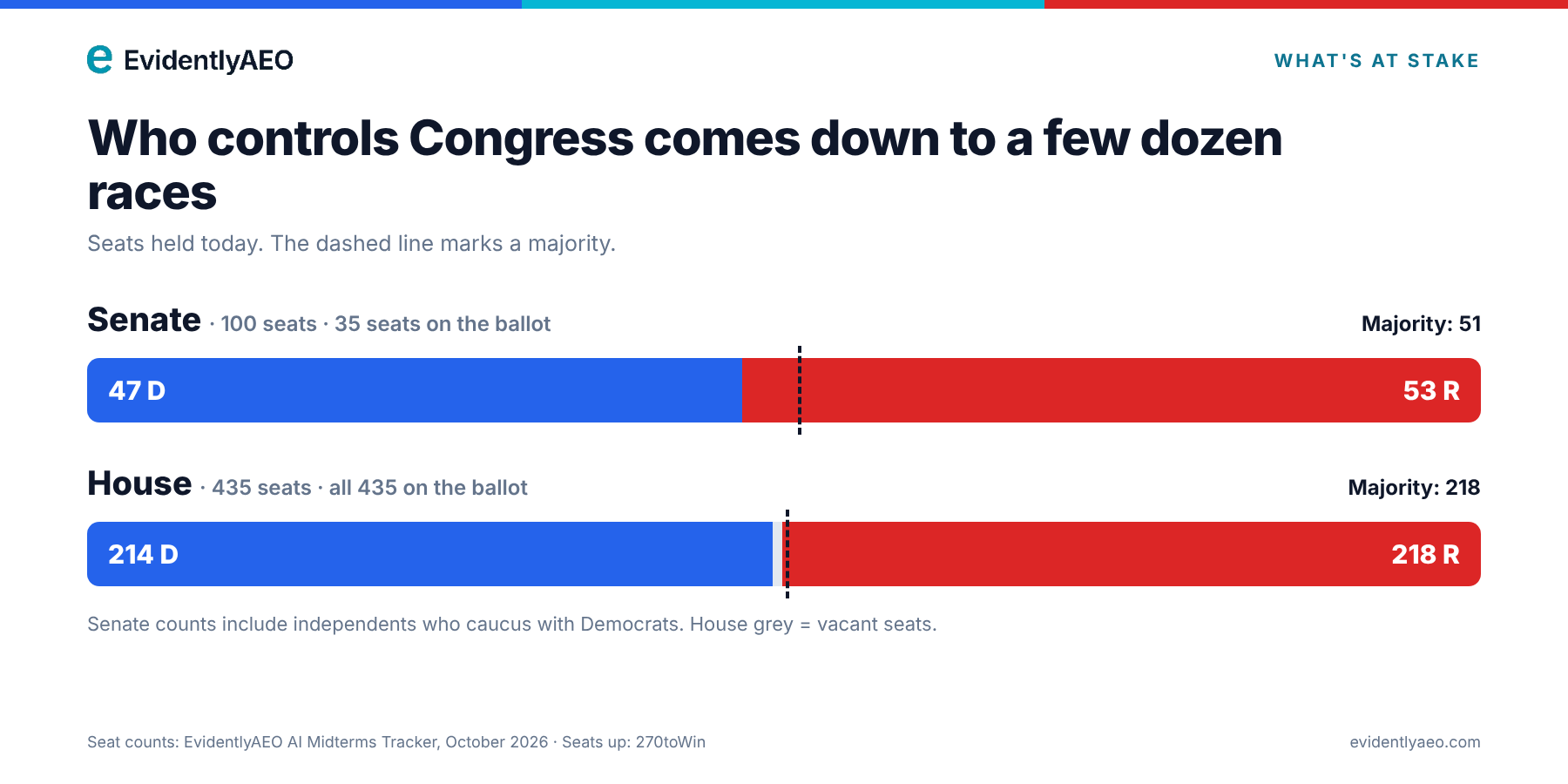
Figure: Seats held going into the 2026 midterms: Senate 47 Democrats, 53 Republicans (majority 51); House 214 Democrats, 218 Republicans (majority 218)
That is why searches like "democrats midterm election expectations" and "2026 competitive senate races" are climbing this week: control of both chambers comes down to a few dozen close contests.
Four kinds of election prediction, and how to read each
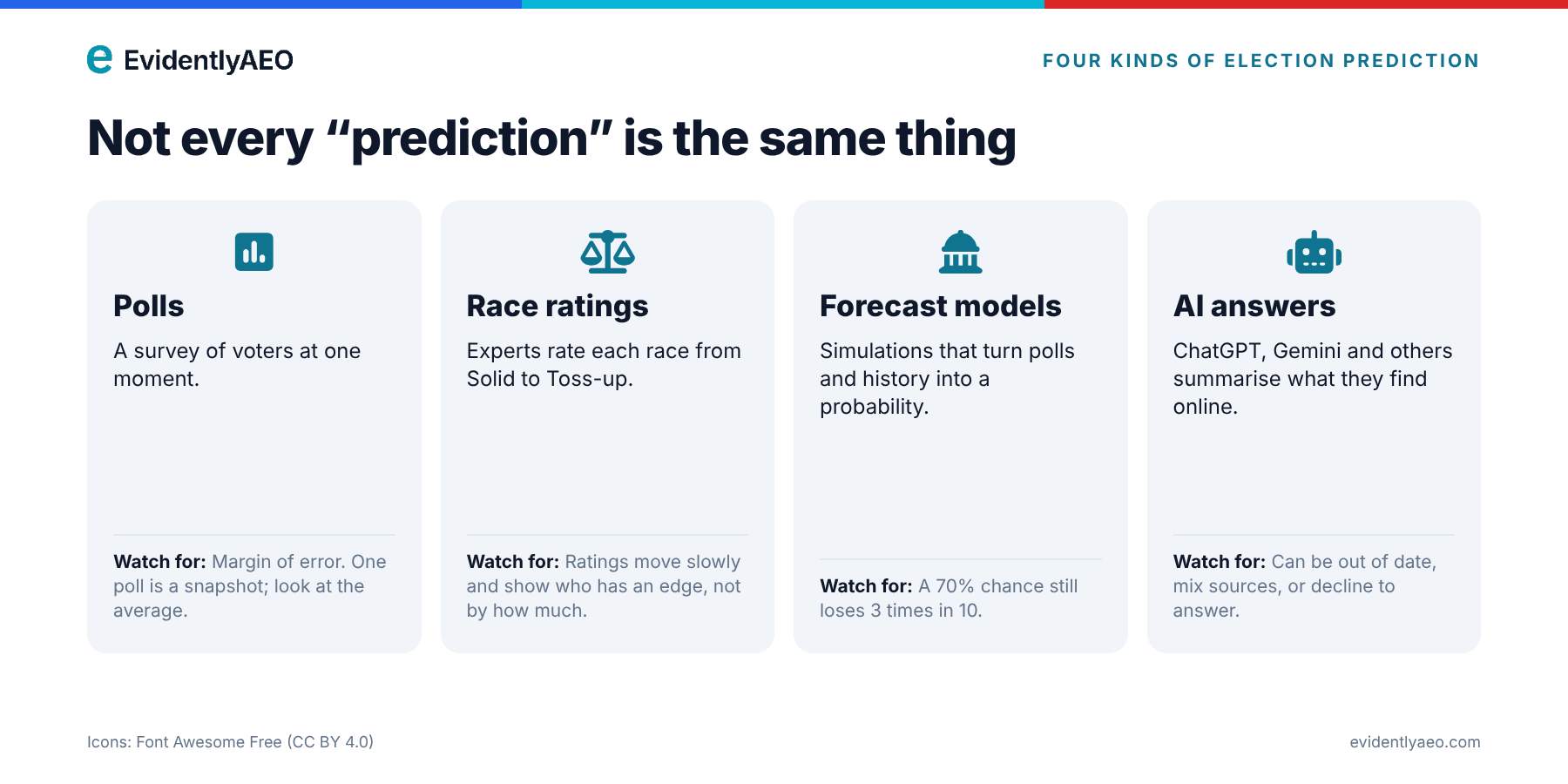
Figure: Four kinds of election prediction: polls, race ratings, forecast models and AI answers, and what to watch for in each
Polls ask a sample of voters what they think on a given day. Every poll has a margin of error, and a single poll can be an outlier, so look at the average of several recent polls, not the latest headline.
Race ratings are expert judgements of how competitive each race is. They do not predict a vote share. They move slowly and tell you which party has an edge, not how big it is.
Forecast models combine polls, past results and other data, then run the election thousands of times to produce a probability. A candidate with a 70% chance of winning still loses in 3 out of 10 simulations, so a 70% favourite losing is not a model failure.
AI answers are the newest source. When you ask an assistant "who is favored in the Texas Senate race?", it searches the web, reads a mix of sources and writes a summary. It is not running a model or conducting a poll.
How to read a race rating
The three best-known raters are the Cook Political Report, Sabato's Crystal Ball and Inside Elections. All three use a similar 7-step scale:
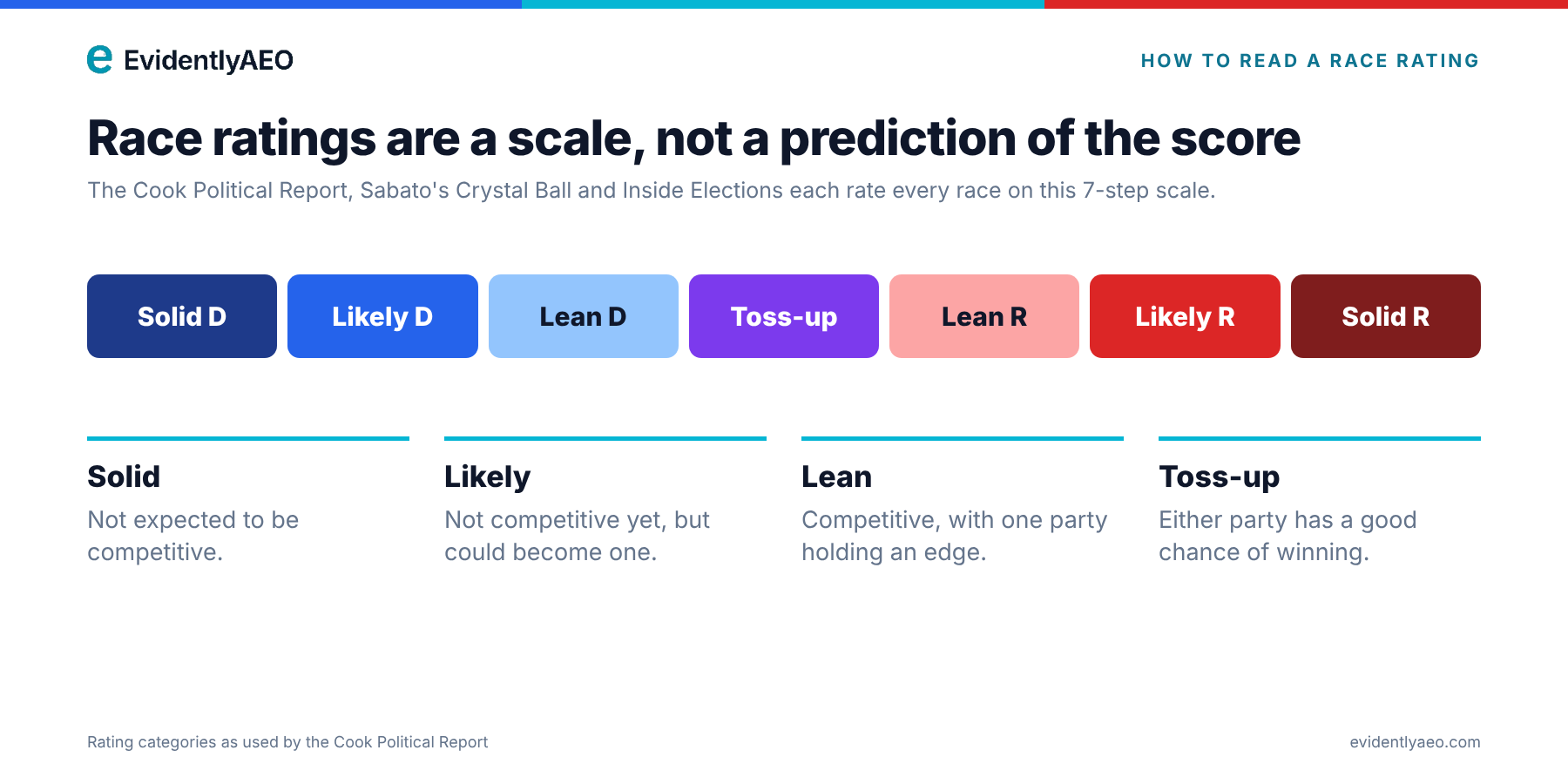
Figure: The 7-step race rating scale used by Cook, Sabato and Inside Elections, from Solid Democrat to Solid Republican
- Solid: not expected to be competitive.
- Likely: not competitive now, but could become one.
- Lean: competitive, with one party holding an edge.
- Toss-up: either party has a good chance of winning.
When the three raters disagree on a race, treat that race as more uncertain than any single rating suggests.
The competitive Senate races of 2026
These are 10 of the most competitive Senate races, chosen from the Cook, Sabato and Inside Elections ratings as the contests most likely to decide control of the Senate. The Texas, Maine and Michigan races are each searched thousands of times a month.
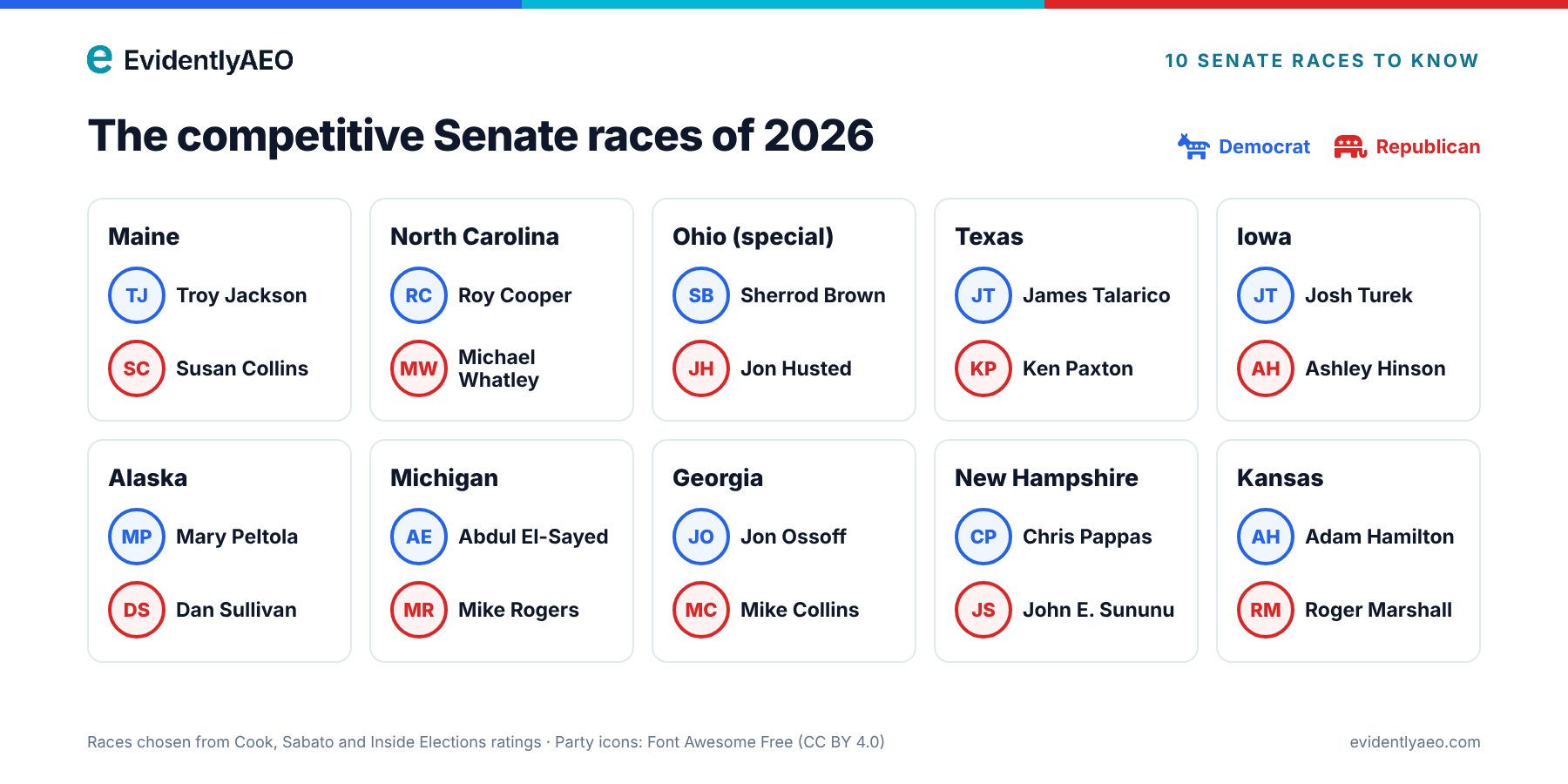
Figure: 10 competitive 2026 Senate races and the Democratic and Republican candidate in each
- Maine: Troy Jackson (Democrat) vs Susan Collins (Republican)
- North Carolina: Roy Cooper (Democrat) vs Michael Whatley (Republican)
- Ohio (special): Sherrod Brown (Democrat) vs Jon Husted (Republican)
- Texas: James Talarico (Democrat) vs Ken Paxton (Republican)
- Iowa: Josh Turek (Democrat) vs Ashley Hinson (Republican)
- Alaska: Mary Peltola (Democrat) vs Dan Sullivan (Republican)
- Michigan: Abdul El-Sayed (Democrat) vs Mike Rogers (Republican)
- Georgia: Jon Ossoff (Democrat) vs Mike Collins (Republican)
- New Hampshire: Chris Pappas (Democrat) vs John E. Sununu (Republican)
- Kansas: Adam Hamilton (Democrat) vs Roger Marshall (Republican)
Early voting is already under way in many states. In Texas, searches for early voting turnout numbers have jumped more than twentyfold this week on Google Trends.
How AI assistants answer election questions
More voters now ask an AI assistant about the election, the same way they ask it about anything else. Knowing how those answers are built helps you read them.
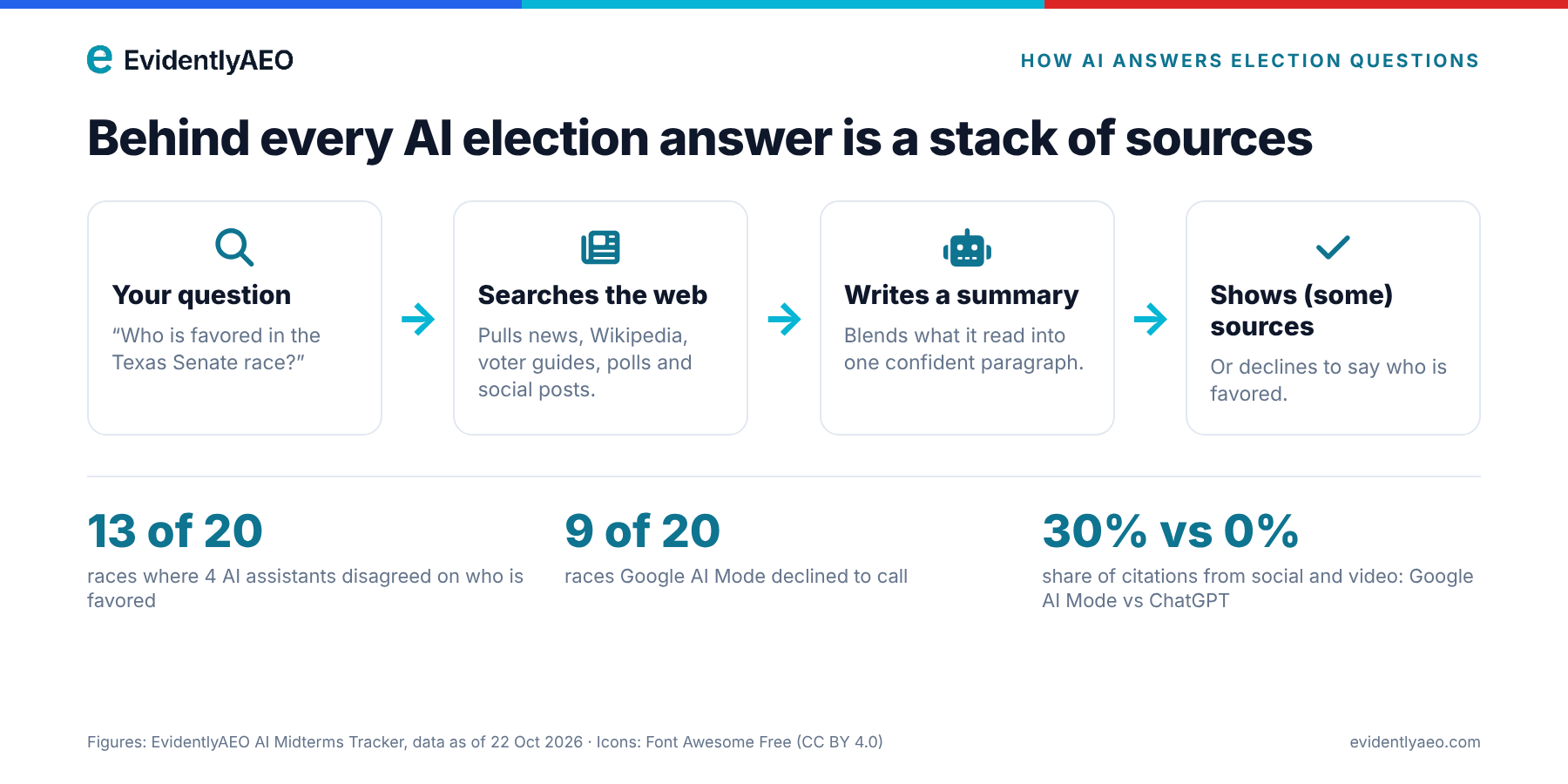
Figure: How an AI assistant builds an election answer, with figures from the EvidentlyAEO AI Midterms Tracker (data as of 22 Oct 2026)
An assistant takes your question, searches the web, and writes one confident paragraph from what it found. Three things follow from that:
- Different assistants give different answers. In our own daily tracking of 20 close races, ChatGPT, Gemini, Perplexity and Google AI Mode disagreed on who is favored in 13 of the 20 (data as of 22 October 2026).
- Some assistants decline. Google AI Mode declined to say who was favored in 9 of the 20 races, while ChatGPT and Perplexity answered all 20.
- The sources vary a lot. 30% of Google AI Mode's citations came from social media and video. For ChatGPT, it was 0%.
None of this makes AI answers useless. It means an AI answer is a summary of other people's work, and you should check it the way you would check any summary.
6 checks before you trust an AI election answer
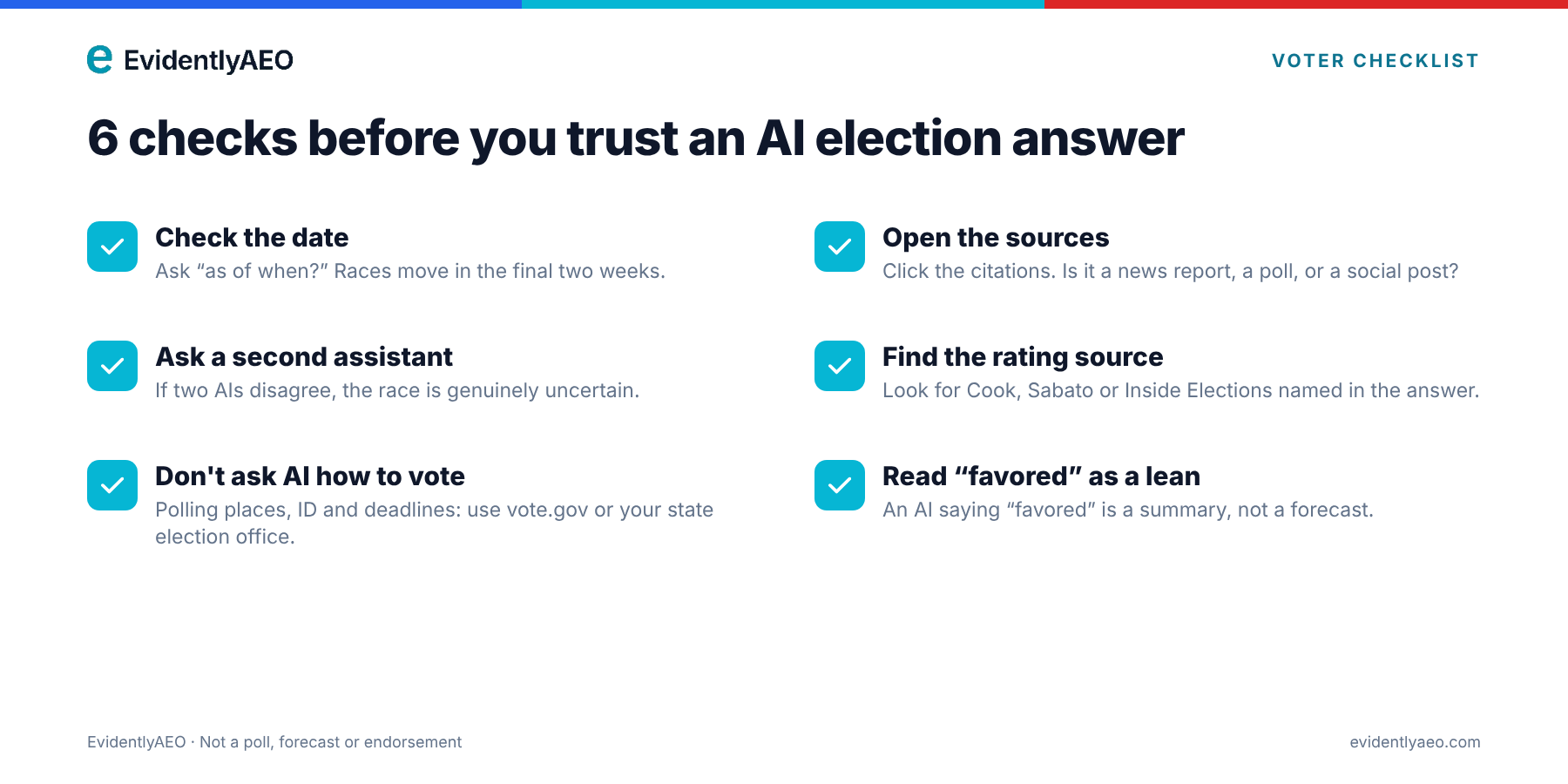
Figure: 6 checks before you trust an AI election answer
- Check the date. Ask "as of when?" Races can move in the final two weeks.
- Open the sources. Click the citations and see whether they are news reports, polls or social posts.
- Ask a second assistant. If two assistants disagree, the race is genuinely uncertain.
- Find the rating source. A good answer names who rates the race (Cook, Sabato or Inside Elections).
- Don't ask AI how to vote. For polling places, ID rules and deadlines, go to vote.gov or your state election office.
- Read "favored" as a lean. An assistant saying a candidate is "favored" is summarising other sources, not forecasting the result.
Why a marketing company writes about elections
EvidentlyAEO measures what AI assistants say about brands: which ones they recommend, which sources they trust, and how that changes day to day. Elections are the clearest public example of the same pattern. The answer you get depends on which assistant you ask and what it read that morning.
If you want to see that pattern race by race, our free AI Midterms Tracker shows what each assistant says about all 20 races, updated every morning. If you want to see it for your own brand, here is how EvidentlyAEO works.
Frequently asked questions
When is the 2026 midterm election? Tuesday, 3 November 2026. Many states offer early voting before then.
How many Senate seats are up in 2026? 35: 33 regular elections plus special elections in Ohio and Florida.
Can AI predict the 2026 midterms? No. AI assistants summarise polls, ratings and news they find online. They do not run forecasting models, and they can be out of date or disagree with each other.
Where can I find official voting information? At vote.gov or your state's election office website.
This article explains how election predictions work. It is not a poll, forecast or endorsement. Party icons: Font Awesome Free (CC BY 4.0).


