
When AI Agents Shop for Your Customers: What an Agentic Commerce Audit Checks
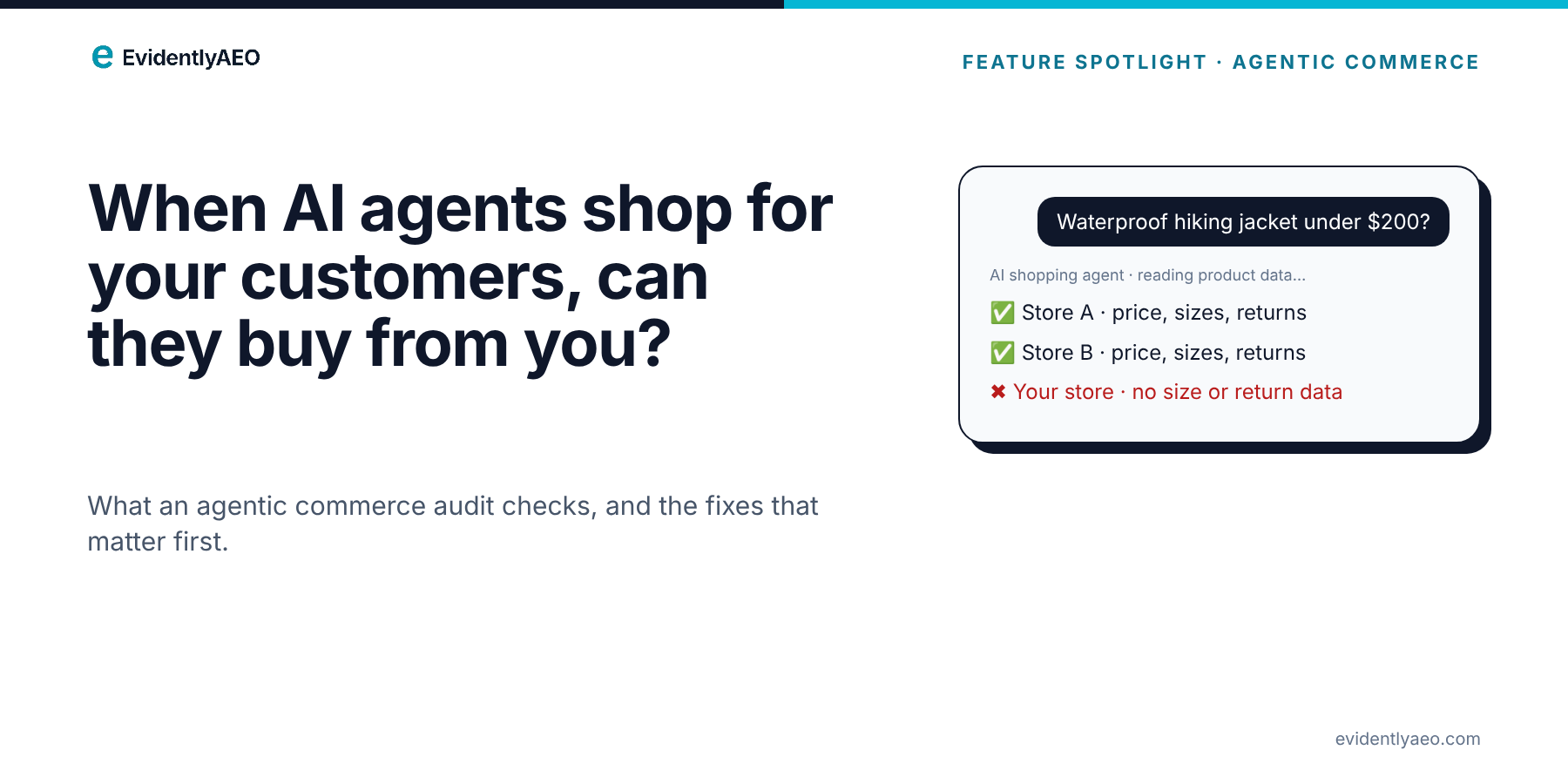
Short answer: An agentic commerce audit checks whether an AI shopping agent can do four things with your store: find every product, read the details it compares on, trust what it reads, and complete a purchase. It then checks the same things on your Amazon, Walmart and Target listings, and ranks the fixes by how much each one improves your score.
Your customer asks ChatGPT for a waterproof hiking jacket under $200. The agent doesn't scroll your homepage or admire your photos. It reads your product data. If the price, the sizes or the return policy aren't there in a form it can read, it moves on to a store where they are, and you never find out you were in the running.
That is the shift behind agentic commerce, and it is why "is my store ready for AI agents?" is now a fair question for any brand that sells online.
Why this matters now
- ChatGPT: OpenAI launched Instant Checkout and the open Agentic Commerce Protocol, built with Stripe, on 29 September 2025. OpenAI says that when several merchants sell the same product, ChatGPT weighs availability, price, quality and whether the merchant is the primary seller.
- Google: on 11 January 2026 Google announced the Universal Commerce Protocol (UCP), an open standard for agents to discover products and check out, starting with checkout in AI Mode and the Gemini app for eligible US retailers.
- The direction of travel: by April 2026 OpenAI was moving from Instant Checkout toward checkouts the merchant controls. The protocols will keep changing; what stays constant is that the agent has to be able to read your catalog first.
So the work for most brands is not "integrate a protocol this week". It is making sure an agent can find and understand your products today, so you are ready whichever checkout wins.
The four things an agentic commerce audit checks
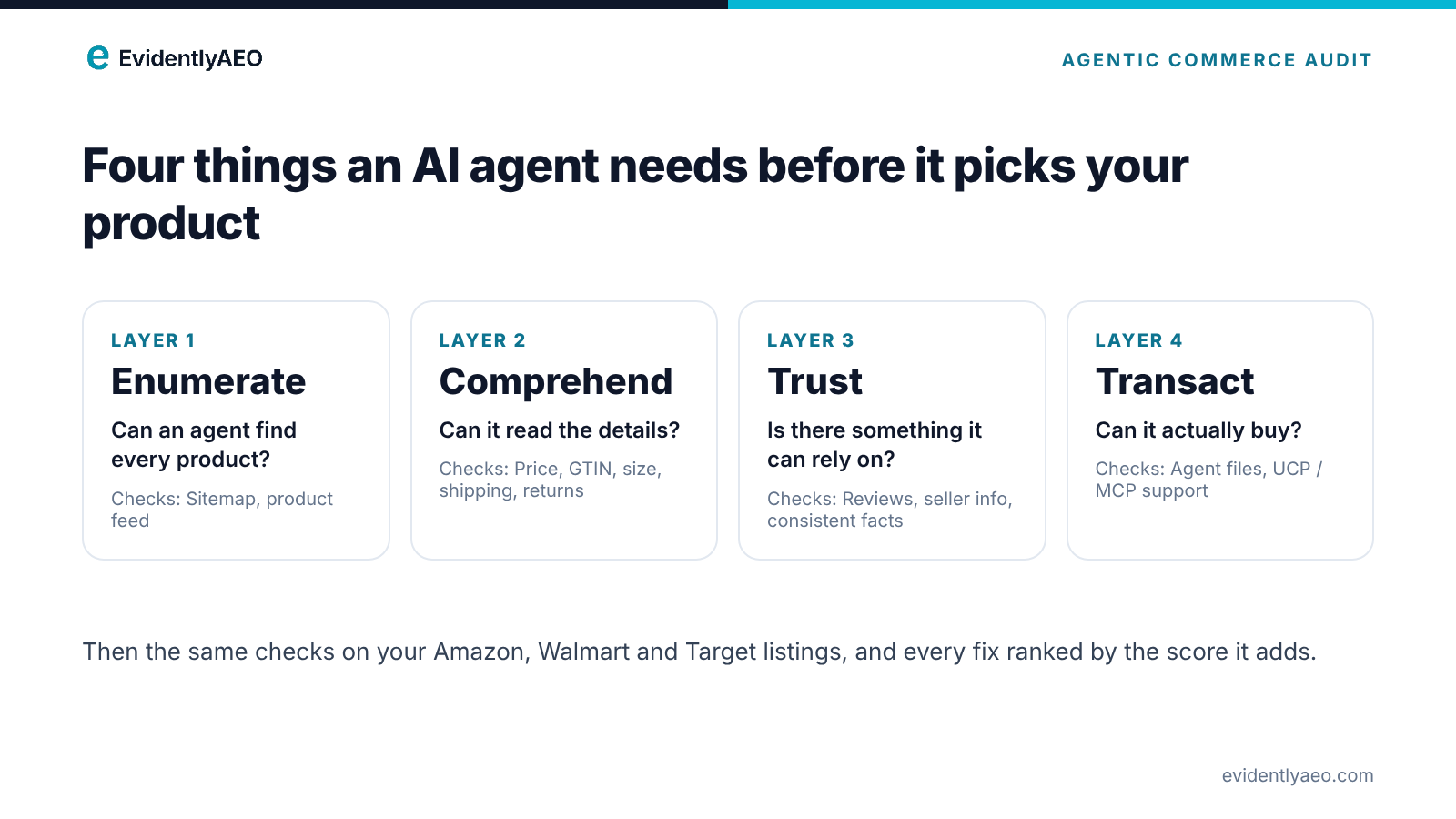
Figure: The four layers of an agentic commerce audit: Enumerate, Comprehend, Trust, Transact
1. Enumerate: can an agent find every product? Agents start from your sitemap and product feed, not your navigation menu. A product that isn't in either is invisible to them. Typical fix: make sure every live product is in the sitemap and in a product feed an agent can read.
2. Comprehend: can it read the details? Agents compare on structured fields: price, availability, brand, GTIN, size, material, shipping and returns. If those live only in images or in a paragraph of copy, the agent has to guess. Typical fix: add the missing fields to your product structured data, once, in the product page template.
3. Trust: is there something it can rely on? Ratings, reviews, clear seller and return information, and consistent facts across your site and your retailer listings. Typical fix: show review counts and return terms in the product data, and make the price and specs match everywhere the product is sold.
4. Transact: can it actually buy? This is where the protocols come in: agent-facing files and support for standards such as UCP or MCP. Typical fix: start with what your platform already offers, and add the agent-facing files your checkout partner supports.
Your Amazon, Walmart and Target listings count too
Agents also buy through retailers. If your Walmart listing is missing the size chart a competitor's listing has, the agent has an easy reason to pick theirs. A good audit scans your listings on each retailer separately, compares them with competitors on the same retailer, and lists the shopper questions your listings leave unanswered, such as "Is it dishwasher safe?"
What a useful fix list looks like
- Ranked by impact. Each fix shows the points it is estimated to add, so the team starts with what moves the score most.
- Template-wide before page-level. Fixing one product template can improve hundreds of pages at once. Fixing one product's description improves one.
- An owner per fix. Most fixes belong to the developer (templates, feeds), some to content (descriptions, answers to shopper questions), a few to marketing (retailer listings).
- Re-checked over time. Run the audit again after each batch of fixes, so the change shows up as a score, not a claim.
Five checks you can do yourself today
- Count your products in the sitemap. Does it match the number in your store admin?
- Test one product page in Google's Rich Results Test. Are price, availability, brand and GTIN all there?
- Look for your shipping and return terms in the product data, not just on a separate policy page.
- Ask ChatGPT and Gemini for your product type in your price range. Are you named? Which store do they send people to?
- Open your best-selling product on Amazon or Walmart next to a competitor's. Which listing answers more questions?
How EvidentlyAEO runs the audit
Our Agentic Commerce audit scores your store from 0 to 100 across the four layers above, scores every product, ranks the fixes by the points each adds, and scans your Amazon, Walmart and Target listings against competitors. Every audit is kept, so you can show the score moving after each round of fixes. To see which products AI already recommends today, pair it with Shopping Intelligence.
Frequently asked questions
**What is agentic commerce?**Shopping done by an AI agent on a buyer's behalf: it finds products, compares them and can complete the purchase.
**Do I need to support UCP or the Agentic Commerce Protocol right now?**Not before the basics. Both depend on an agent being able to find and read your products first. Fix discovery and product data, then add the protocol your platform and checkout partner support.
**Is this different from SEO?**It overlaps: sitemaps and structured data help both. The difference is that an agent compares products field by field to make a choice, so missing fields cost you the sale, not just a ranking.
**Does it matter for B2B or only for retail?**It matters most for brands that sell products online, directly or through retailers. B2B brands without online checkout should still make their product data readable, because agents use it to build shortlists.
Sources: OpenAI, "Buy it in ChatGPT: Instant Checkout and the Agentic Commerce Protocol" (29 September 2025); Google, announcement of the Universal Commerce Protocol (11 January 2026); Checkout.com, "OpenAI's agentic commerce shift" (20 April 2026).


