AI Summaries Halve Google Clicks. What to Measure Instead
When Google shows an AI summary, people click far less. In Pew Research Center's analysis of browsing data from 900 US adults in March 2025, users clicked a traditional search result on 8% of visits to a results page with an AI summary, against 15% on pages without one. They clicked a link inside the summary itself on just 1% of visits.
For marketing teams, the bigger change is not the lost clicks. It is that website traffic now tells you less about whether buyers saw your brand at all.
What Pew found
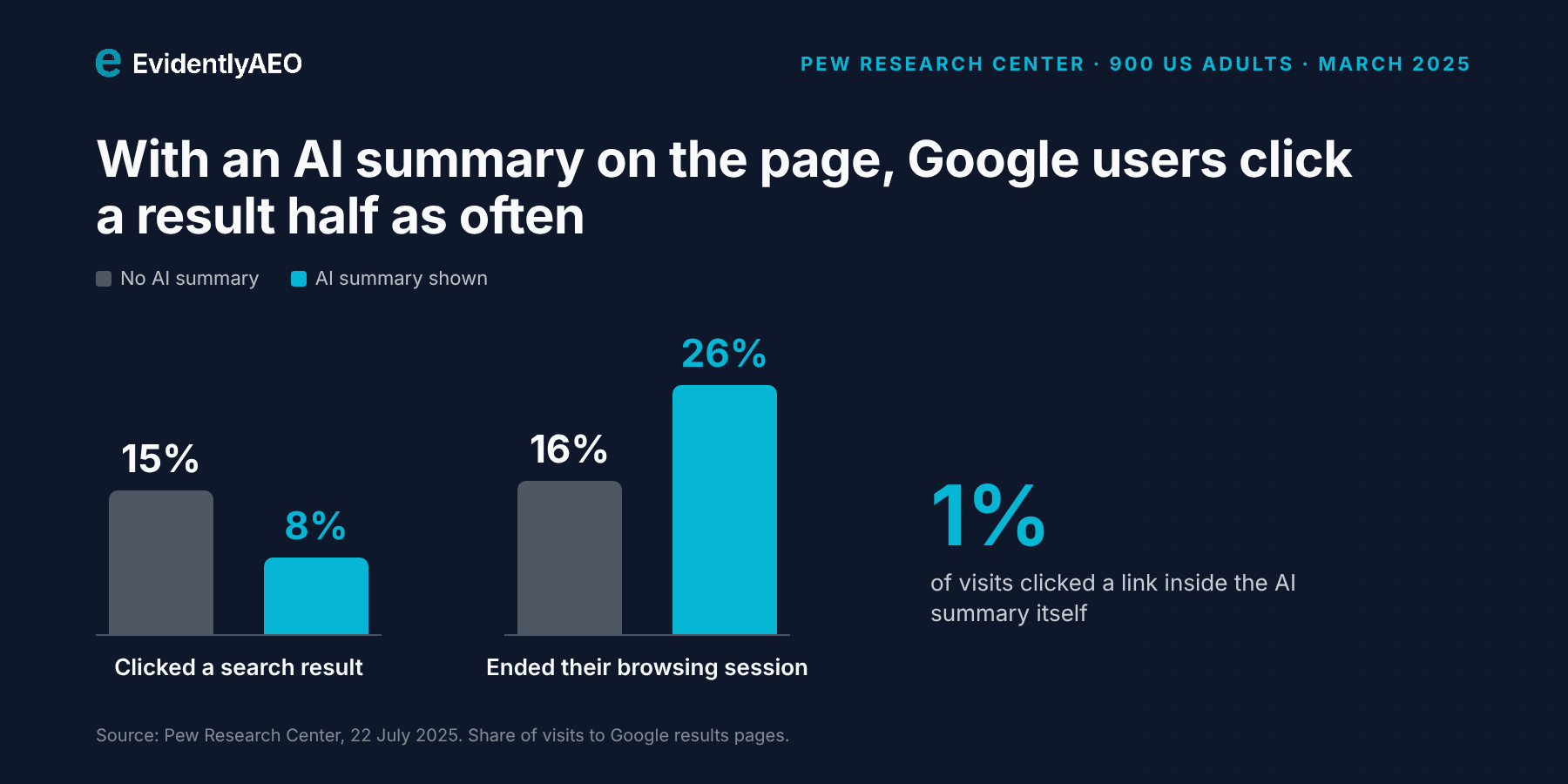
Figure: With an AI summary on the page, users clicked a search result on 8% of visits versus 15% without one, and ended their session more often (26% vs 16%). Source: Pew Research Center.
- Clicked a traditional search result: 8% of visits when an AI summary appeared, versus 15% when none did.
- Clicked a link inside the summary: 1% of visits.
- Ended the browsing session on that page: 26% with an AI summary, versus 16% without one.
Three other findings matter just as much:
- 18% of the Google searches in the sample produced an AI summary.
- Long, question-shaped searches triggered summaries far more often. Only 8% of one- or two-word searches produced one, compared with 53% of searches of ten words or more and 60% of searches that began with a question word.
- The median summary was 67 words long, and 88% of summaries cited three or more sources. Wikipedia, YouTube and Reddit were the most cited, making up 15% of all summary sources.
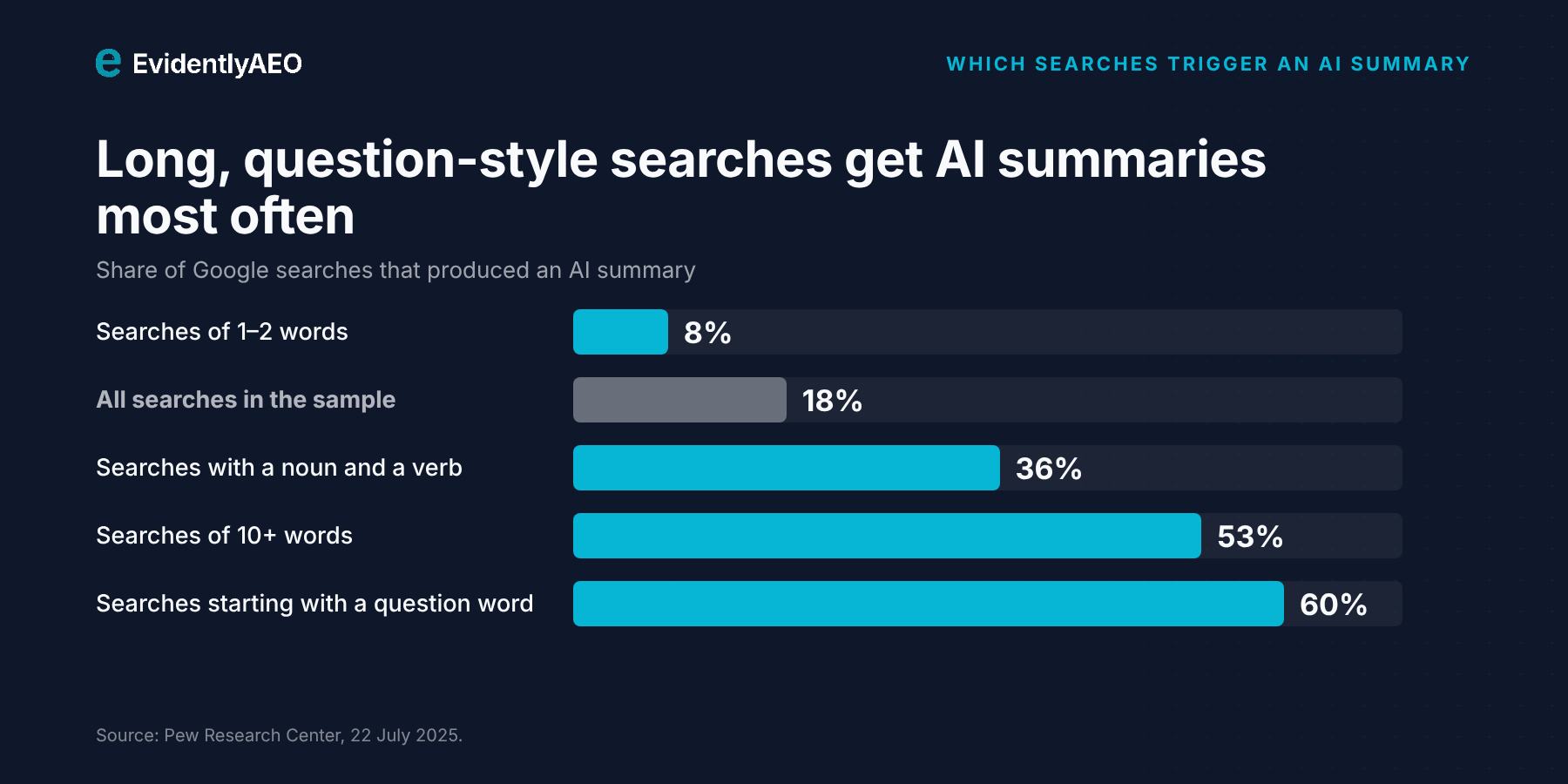
Figure: The longer and more question-like the search, the more likely Google shows an AI summary. Source: Pew Research Center.
Why B2B brands should pay close attention
Our reading of the data: the searches most likely to produce a summary look a lot like how buyers research a category. "What is the best tool to track brand mentions for a small marketing team" is 14 words and starts with a question word. "Acme login" is two words and neither.
That means the research stage, where shortlists form, is where clicks are disappearing first. A buyer can read a 67-word answer that names three vendors, close the tab, and book a demo with one of them a week later. Your analytics will record none of it.
Traffic now under-reports your reach
Before AI summaries, a fall in organic traffic usually meant a fall in rankings or demand. Now it can also mean the opposite: you are being read about more, and clicked less.
Rankings do not fill the gap either. A page can hold position one while the AI summary above it names a competitor. The question that matters is no longer only "where do we rank?" but "are we named in the answer, and how?"
What to measure alongside traffic
Four numbers describe how a brand shows up in AI answers:
- Brand Presence: the percentage of tracked AI answers that mention your brand at all.
- Share of Answer: your brand's mentions divided by the mentions of every tracked brand, times 100. It shows your position against competitors. How Share of Answer is calculated.
- Citations: which of your pages AI engines link to as sources, and which competitor or third-party pages they cite instead.
- Sentiment and accuracy: whether what the answer says about you is positive and correct.
Measure them on a fixed set of buyer questions, written the way buyers actually ask: long and question-shaped, because those are the searches that trigger summaries. Run the same questions across the AI engines your buyers use, and read the results as a trend over weeks rather than a single check.
Where to start this week
- Write down 20 questions a buyer asks before contacting sales, in full sentences.
- Search each one in Google. Note whether an AI summary appears, which brands it names, and which sources it cites.
- Ask the same questions in ChatGPT and Perplexity and note the same three things.
- Mark every question where a competitor is named and you are not. That list is your content plan.
For the manual version of step 3, see how to check if ChatGPT mentions your brand. To run it across seven AI engines on a schedule, see EvidentlyAEO Visibility Tracking. For the wider discipline behind it, read What Is Answer Engine Optimization?
Search traffic still matters. It just no longer shows the whole picture, and the part it misses is the moment buyers decide who makes the shortlist.
Sources
- Pew Research Center, Google users are less likely to click on links when an AI summary appears in the results, 22 July 2025.


