
Why AI Content Can Backfire in AI Search
A lot of marketing teams are using AI tools to produce content faster. I understand the appeal. It feels efficient, scalable, and easy to justify when everyone is under pressure to publish more.
But I think there’s a real risk in taking that approach too far. If every brand starts producing the same kind of synthetic, high-volume content, it becomes harder to stand out in search, harder to build trust, and harder to earn a real citation from AI-driven systems.
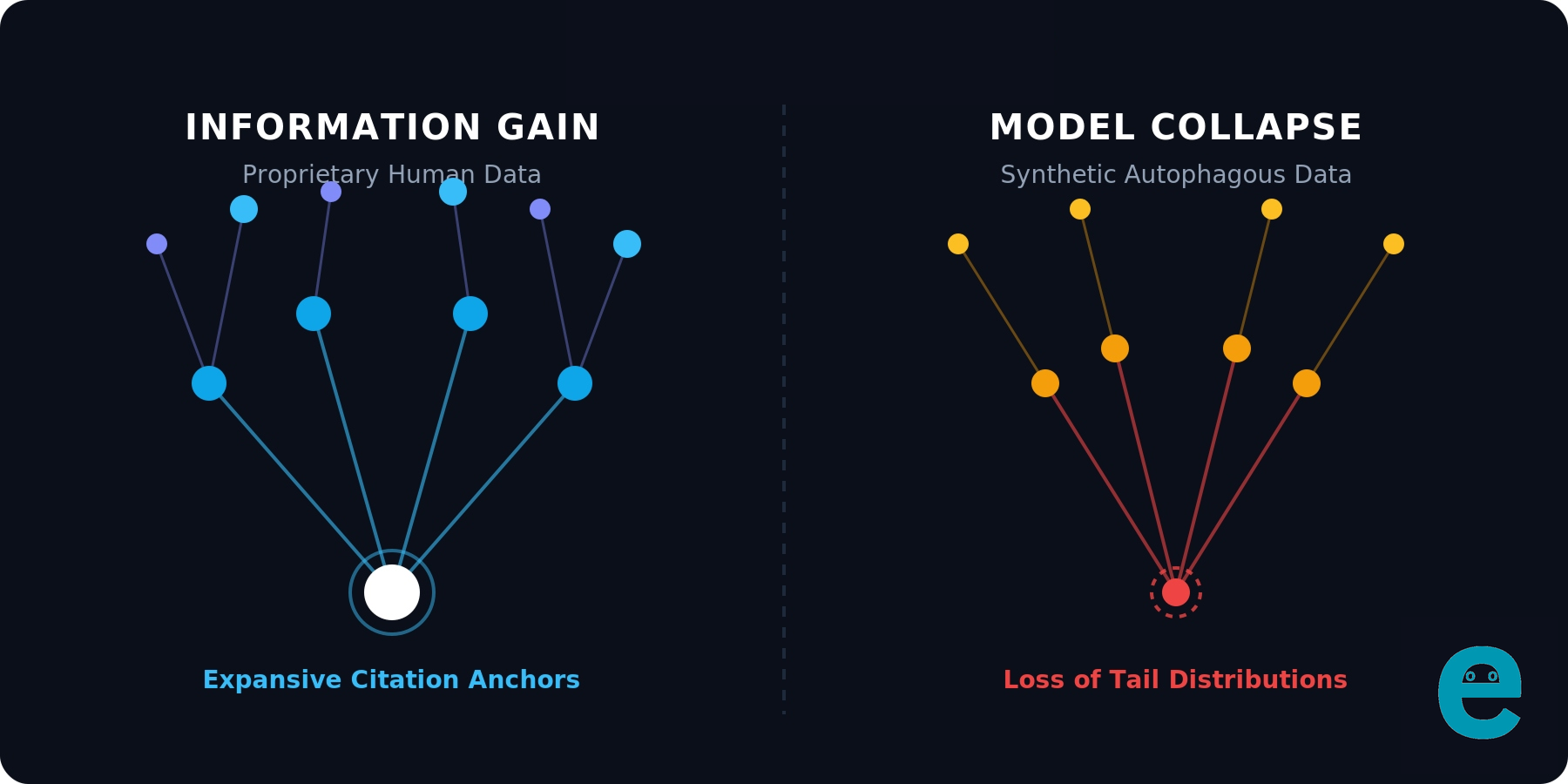
Figure: High-entropy human data produces expansive citation anchors (left). Synthetic autophagous data converges into collapsed tail distributions (right).
What happens when content gets too generic
Search is changing. People are asking tools like ChatGPT, Perplexity, and Google’s AI features for answers, not just clicking through a page of blue links. That means brands need to think about whether their content is actually useful to an answer engine, not just whether it ranks for a keyword.
The problem is that generic AI-generated content often adds very little new information. It tends to rephrase what is already out there, which makes it less valuable for systems trying to pull together a grounded answer. If your site mostly repeats the same ideas everyone else has already published, it becomes easy to overlook.
To show exactly how this happens, I built a live mathematical simulator. It demonstrates the "Autophagous Engine" loop—showing how training an AI on its own synthetic output strips away nuanced "tail distributions" of data. You can play with the Model Collapse Simulator below to see how synthetic flooding mathematically degrades search visibility in real-time.
Why originality matters more
What seems to matter now is whether your content gives the model something concrete to work with. That could be original research, a clear point of view, firsthand experience, a strong definition, or a useful comparison that explains something better than competing pages.
In practice, that means brands should focus less on flooding the web with more articles and more on making the content they already have easier to trust and easier to cite. That includes updating older pages, tightening internal links, filling obvious content gaps, and being more direct about important claims.
The better strategy
I don’t think the answer is “publish as much as possible.” I think it’s “publish something worth referencing.” If a page gives AI systems and human readers a reason to trust it, it has a much better chance of being surfaced, quoted, or linked.
That’s especially true as AI search becomes more common. The brands that win will be the ones that sound clear, specific, and genuinely informed — not the ones that publish the most synthetic content.
A simpler way to say it
If I had to put it in one sentence, I’d say this:
The goal is not to create more content than everyone else. The goal is to create content that is more useful, more credible, and harder to ignore.