
What AI Says on the Eve of the 2026 Midterms: 20 Races, 4 Assistants
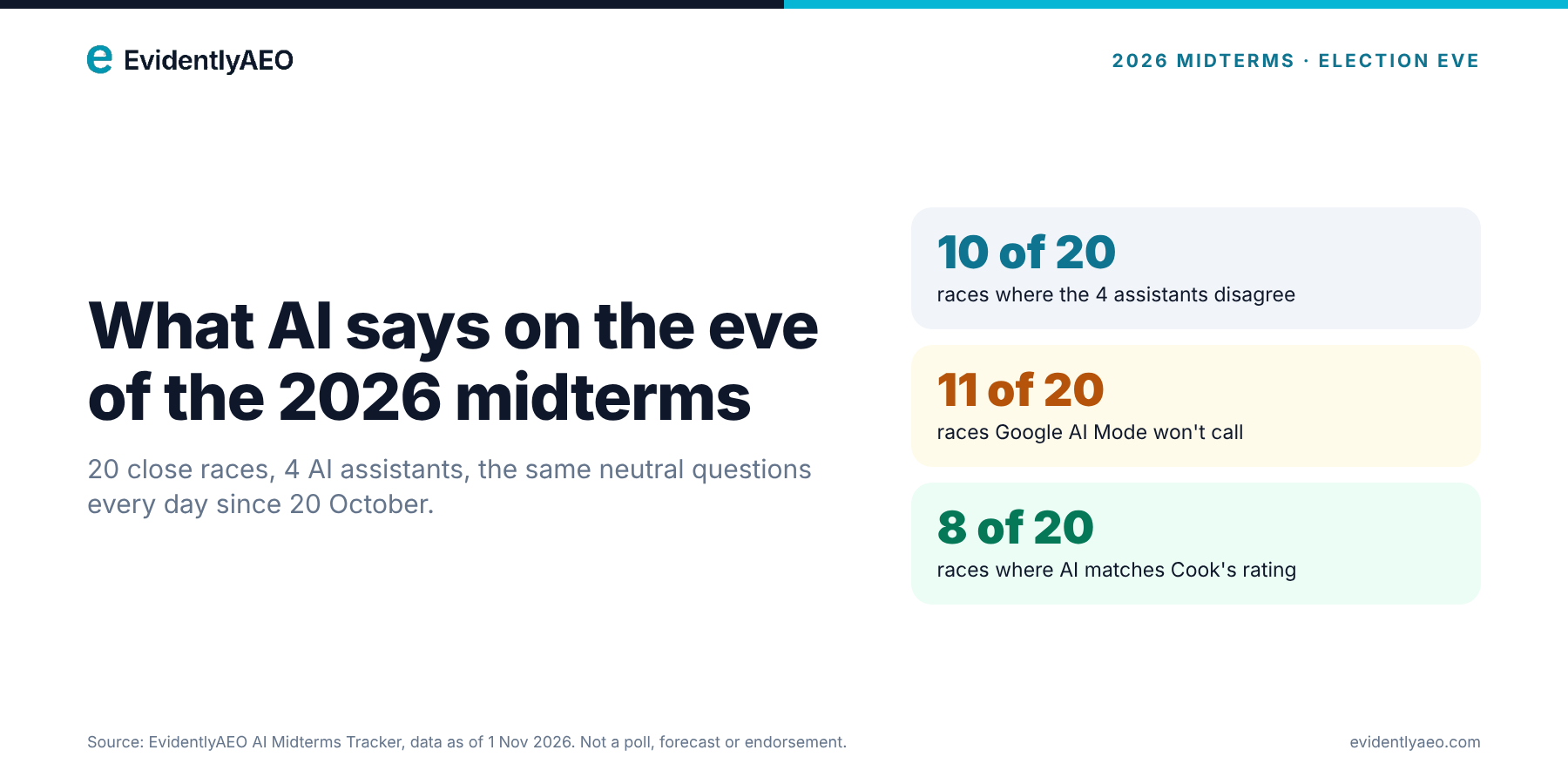
Tomorrow, 3 November 2026, Americans vote in the midterm elections. For the past two weeks we have asked four AI assistants (ChatGPT, Google AI Mode, Gemini and Perplexity) the same neutral questions about 20 of the closest Senate and House races, every morning. Here is what their answers looked like on the eve of the vote, and what changed since we started on 20 October.
This is a summary of what AI assistants say. It is not a poll, a forecast or an endorsement, and it does not say who will win.
1. AI answers got more decisive
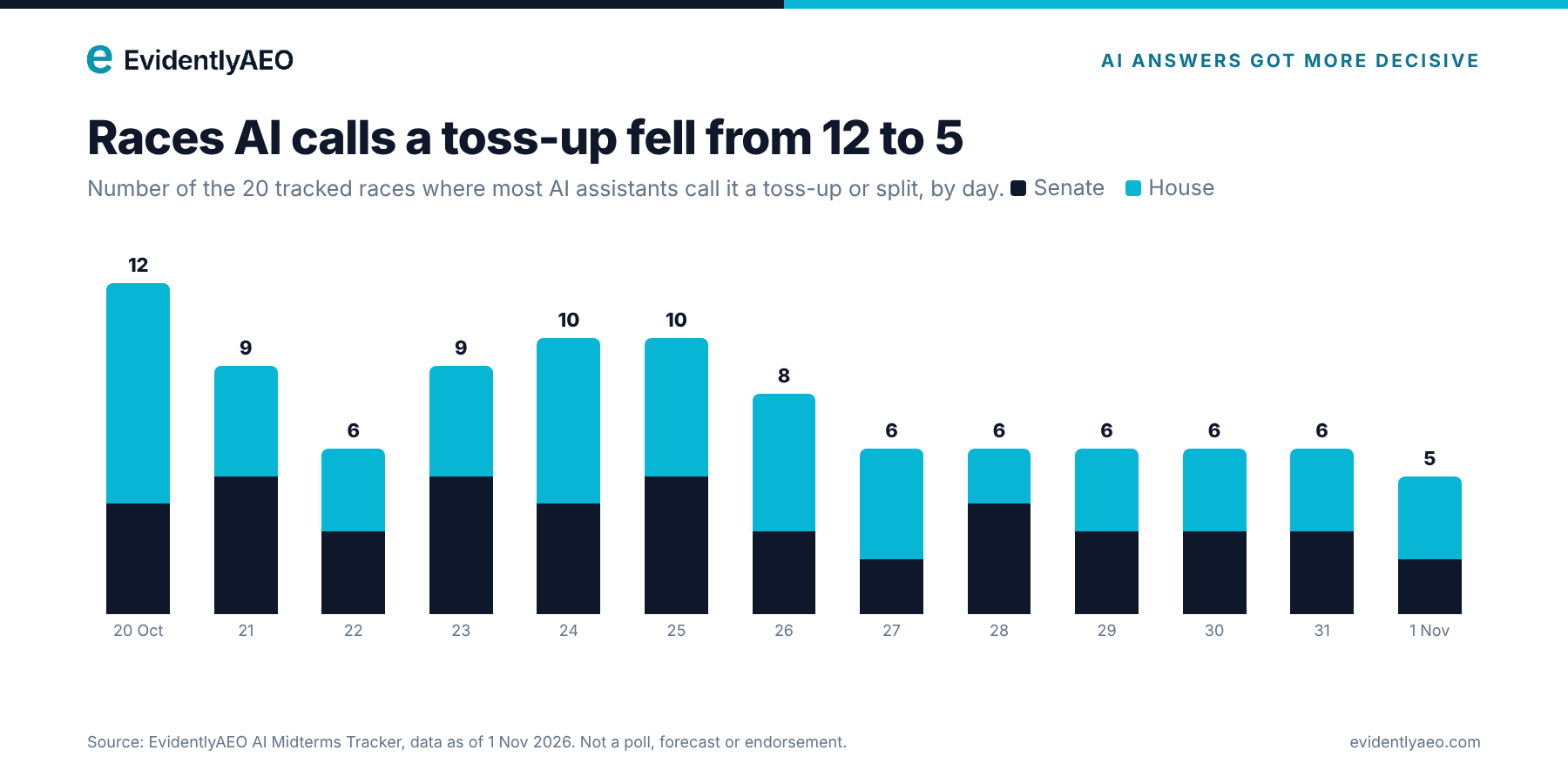
Figure: Races AI calls a toss-up fell from 12 to 5 between 20 October and 1 November 2026
On 20 October, most assistants called 12 of the 20 races a toss-up or split their answers. By 1 November that had fallen to 5. As more polls and news coverage appeared, the assistants increasingly named a favourite. That does not mean they are right: an AI answer summarises what it reads, and late coverage can move it in either direction.
2. The assistants still disagree on half the races
On 1 November, the four assistants gave different answers to "Who is favored to win?" in 10 of the 20 races. The races they split on most were the NY-17 (Hudson Valley) and VA-2 (Virginia Beach) House races and the Iowa, Alaska and Kansas Senate races.
Disagreement has moved around during the campaign: 13 of 20 races on 22 October, 14 on 29 October and 10 on 1 November. The lesson for voters is simple: one AI answer is one view, not a consensus.
3. One assistant often won't answer
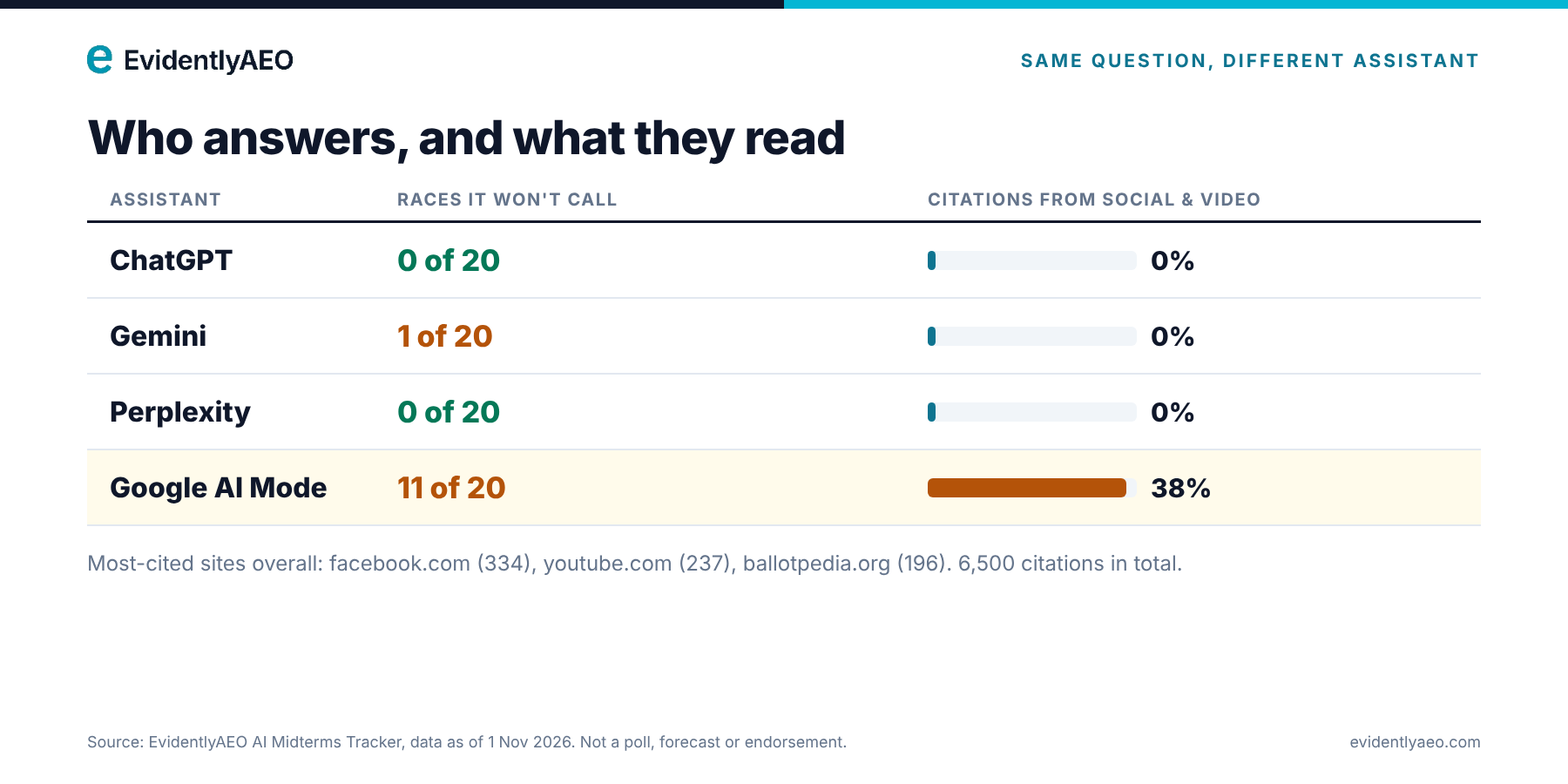
Figure: Who answers, and what they read: races each assistant would not call, and its share of citations from social media and video, 1 November 2026
Google AI Mode declined to say who was favoured in 11 of the 20 races on 1 November. ChatGPT and Perplexity answered all 20, and Gemini declined once. Declining is a reasonable choice for an election question; it just means the same voter gets a very different experience depending on which assistant they open.
4. They read very different sources
Across 6,500 citations on 1 November, 38% of Google AI Mode's citations came from social media and video. For ChatGPT, Gemini and Perplexity it was close to zero. The most-cited sites overall were facebook.com (334 citations), youtube.com (237) and ballotpedia.org (196), followed by yahoo.com and localcandidates.org. Local news and other sites made up 56% of all citations.
When an assistant tells you a candidate is "favored", it helps to know whether that rests on a news report, a poll, a voter guide or a social post. Click the sources.
5. AI and the experts don't always match
We compared each race's overall AI lean with the Cook Political Report rating. They matched in 8 of the 20 races. Expert ratings move slowly and deliberately; AI answers change with whatever the assistant read that morning. Neither is a result.
6. What AI says voters care about
Across the 20 races, the assistants most often listed cost of living (19 of 20 races), healthcare (18) and immigration (13) among voters' top concerns, followed by democracy and accountability, and jobs and the economy (7 each).
Before you vote
- For where, when and how to vote, use official sources: vote.gov or your state election office, not an AI assistant.
- If you use AI to read up on a race, check the date, open the sources and ask a second assistant. Our guide 2026 Midterms Predictions, Explained has six quick checks.
- Read "favored" as a lean, not a forecast.
What we'll publish next
After the results are in, we will compare what each assistant said with what actually happened in all 20 races. You can follow every race until then on the AI Midterms Tracker, updated every morning.
Why a marketing company tracks elections
EvidentlyAEO measures what AI assistants say about brands: which ones they recommend, which sources they trust and how that changes day to day. Elections are the clearest public example of the same pattern: the answer depends on which assistant you ask and what it read that morning. We explain why that makes "rank #1 in ChatGPT" the wrong goal in No Rank #1 in ChatGPT. To see the same measurement for your own brand, take the product tour.
Frequently asked questions
**Can AI predict the 2026 midterms?**No. AI assistants summarise polls, ratings and news they find online. They do not run forecasting models, and they can disagree with each other or be out of date.
**Which AI assistant is most accurate on elections?**We don't know yet. We will compare each assistant's answers with the actual results after 3 November.
**Where does this data come from?**From the EvidentlyAEO AI Midterms Tracker, which asks ChatGPT, Google AI Mode, Gemini and Perplexity the same 10 neutral questions about each of 20 races every morning. Data in this article is as of 1 November 2026.
Source: EvidentlyAEO AI Midterms Tracker, "How AI sees the 20 races that decide Congress," data as of 1 November 2026. This article describes what AI assistants say. It is not a poll, forecast or endorsement.


