
What Is llms.txt, and Does It Help AI Visibility?
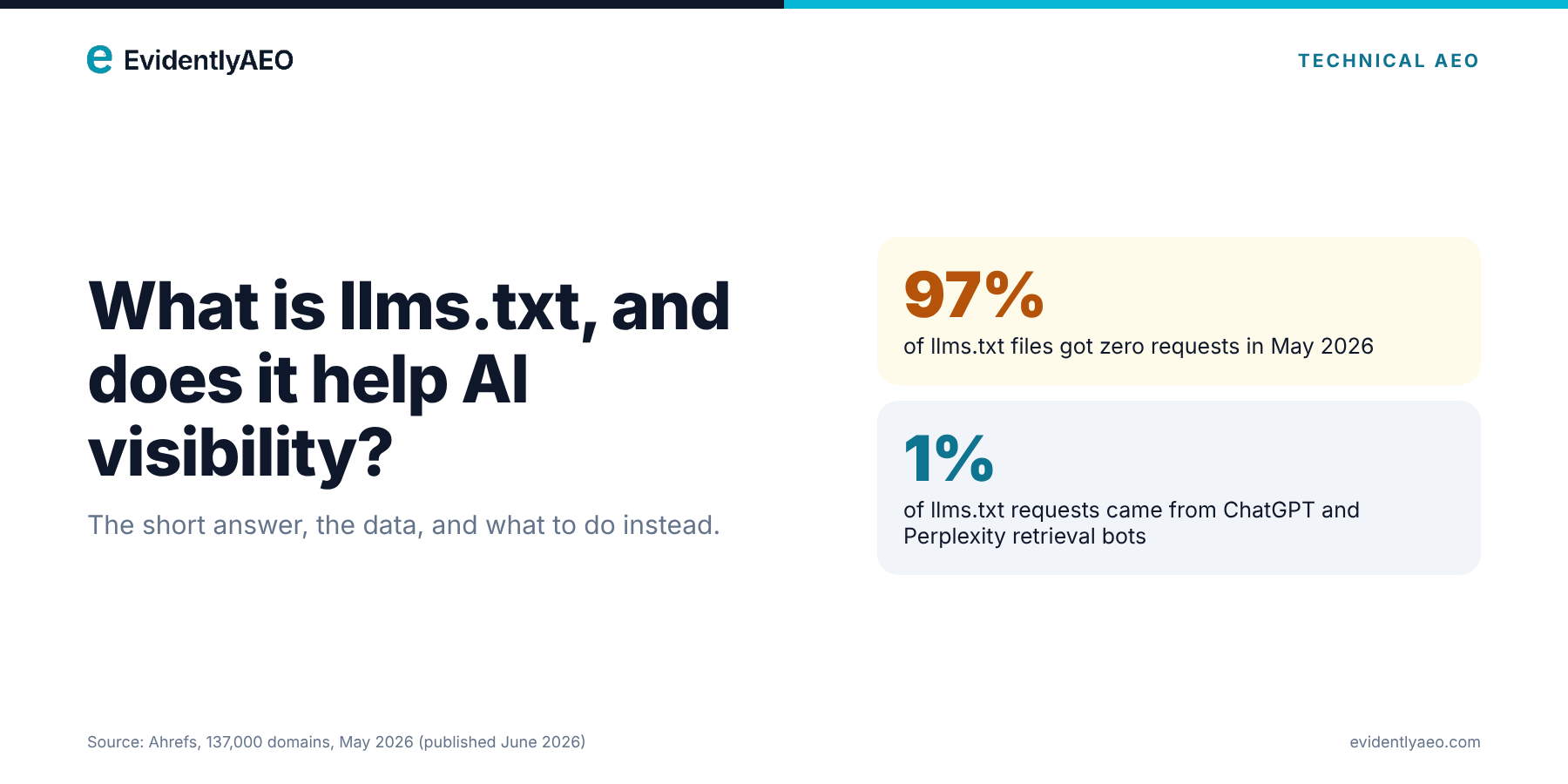
Short answer: llms.txt is a plain Markdown file at yoursite.com/llms.txt that lists your most important pages for AI tools. It was proposed in September 2024 by Jeremy Howard of Answer.AI. Today it does not help you appear in ChatGPT, Gemini or Google's AI answers: Google says it doesn't use it, and almost no AI answer bots request it.
Here's the surprise: about 28% of websites now publish an llms.txt file, but in May 2026, 97% of those files were not requested even once. The bots that write ChatGPT and Perplexity answers made up just 1% of the requests that did happen (Ahrefs study of 137,000 sites).
So should you bother? Below: what the file is, who actually reads it, what Google says, and the few cases where it is still worth five minutes.
What is llms.txt?
llms.txt is a proposed standard for a short Markdown file placed at the root of a website. It gives AI tools a curated starting point: the site's name, a one-line summary, and lists of the most useful pages with a short note on each. The idea, from Jeremy Howard's original proposal, is that a language model shouldn't have to crawl every page or guess which ones matter.
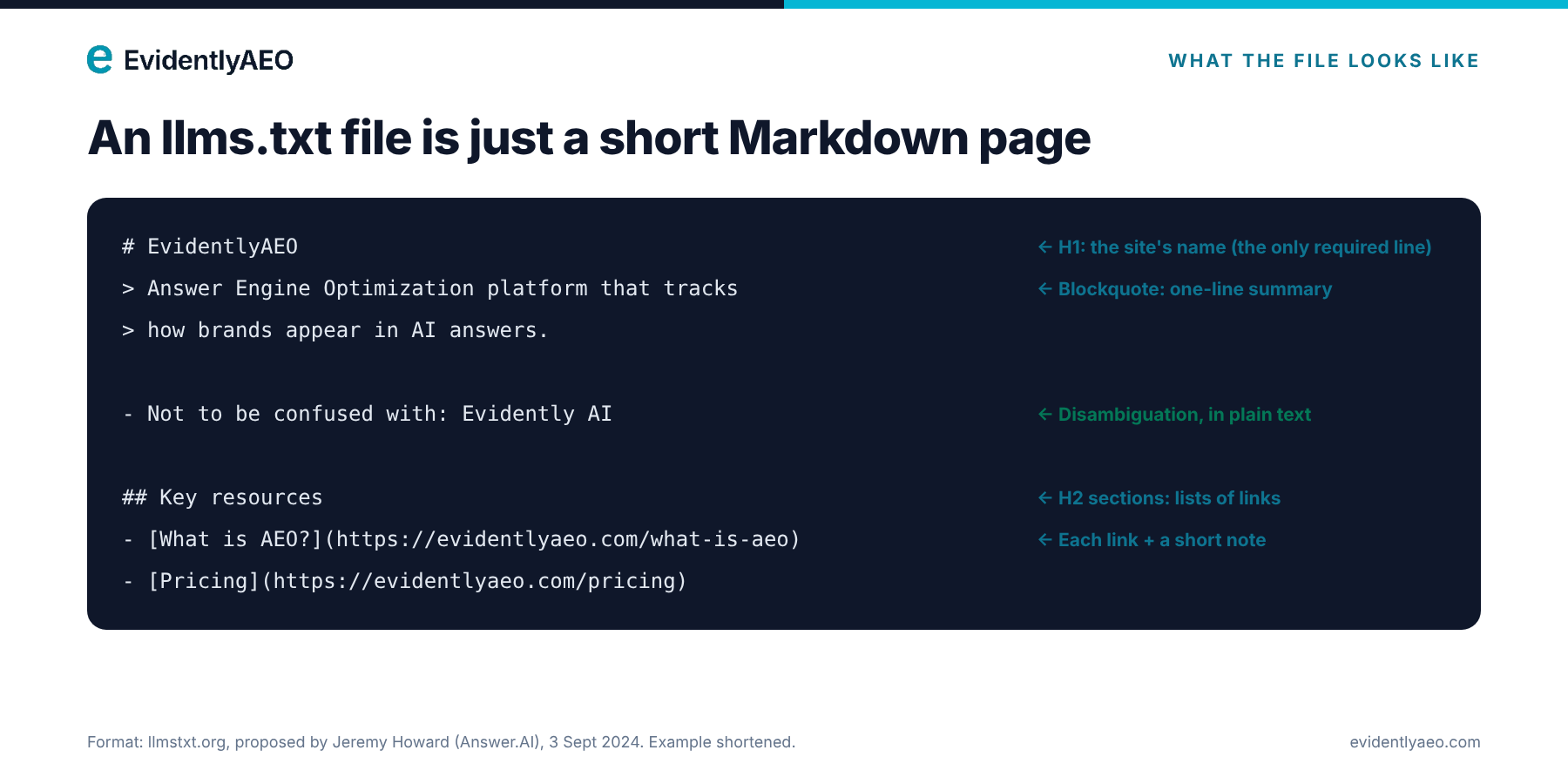
Figure: What an llms.txt file looks like, line by line
The format is simple. Only the first line is required:
- H1: the name of the site or project (required).
- Blockquote: a one- or two-line summary.
- H2 sections: lists of links, each with an optional short note.
- "Optional" section: links an AI tool can skip if it needs less context.
It is not robots.txt. robots.txt tells crawlers what they may access; llms.txt only suggests what to read first, and nothing obliges a bot to open it.
Does ChatGPT, Gemini or Google read llms.txt?
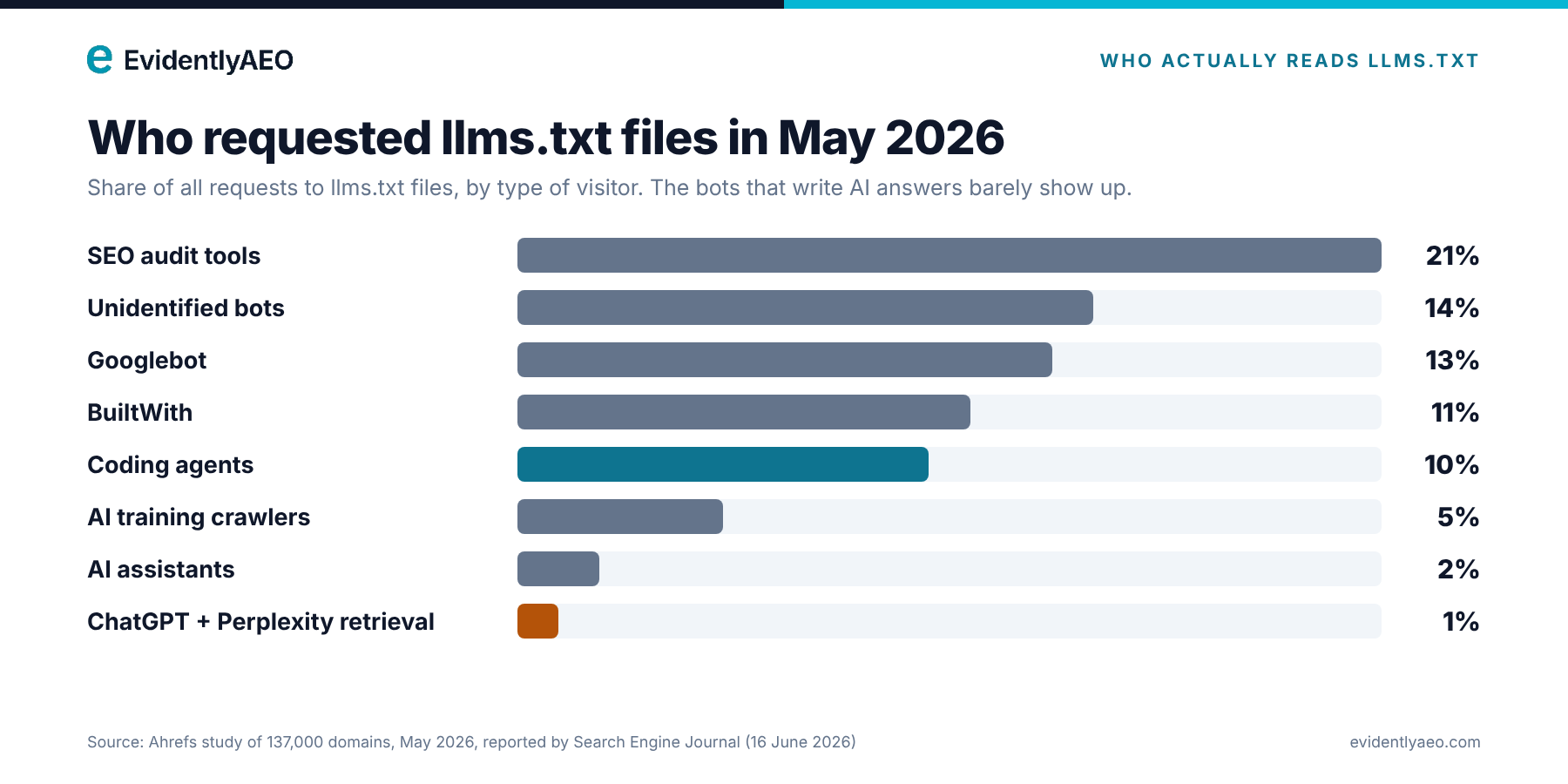
Figure: Who requested llms.txt files in May 2026 (Ahrefs, 137,000 domains)
Mostly no. In Ahrefs' study of 137,000 domains in May 2026, the biggest requesters of llms.txt files were SEO audit tools (21% of requests), unidentified bots (14%), Googlebot (13%) and BuiltWith (11%). Coding agents made up 10%. AI retrieval bots linked to ChatGPT and Perplexity, the ones that fetch pages to answer a question, accounted for about 1%. Even Slackbot fetched llms.txt more often than PerplexityBot.
Google has been the clearest. Its Search team has said it does not use llms.txt and has no plans to: Gary Illyes has said Google isn't pursuing it, John Mueller compared it to the old keywords meta tag, and Google's own guide to AI features in Search lists llms.txt among things you don't need (Search Engine Journal).
There is one twist. In May 2026, Chrome's Lighthouse 13.3 added an experimental "Agentic Browsing" audit that checks for an llms.txt file. That audit is about AI agents using your site inside a browser, not about rankings or citations in AI answers.
OpenAI does not mention llms.txt in its crawler documentation. To appear in ChatGPT search, it asks sites to allow its search crawler, OAI-SearchBot, in robots.txt (OpenAI).
Should you add an llms.txt file?
Add one if it costs you five minutes and you have a clear reason:
- You publish developer documentation. Coding agents are the one group that reads these files in meaningful numbers.
- You want a single, plain-text summary of who you are that you control, including what you are not (for example, a company with a similar name).
- You are preparing for AI agents that browse on a user's behalf, which is what the Lighthouse audit is aimed at.
Don't add one expecting it to make ChatGPT, Gemini or AI Overviews mention you more. There is no evidence it does. If AI visibility is the goal, the work that moves it is elsewhere: crawler access, clear answers in your page text, consistent facts and third-party mentions. Our guide How to Improve Your Brand's Visibility in AI Answers covers those five checks.
What we put in our own llms.txt
We have one at evidentlyaeo.com/llms.txt. It holds the lines we most want any AI tool to get right: what EvidentlyAEO is, the AI engines we track, links to our What is AEO guide, Answers library and blog, and a plain note that we are not Evidently AI, an unrelated company with a similar name.
If you keep an llms.txt, review it whenever your pricing or product changes, the same as any other page.
Frequently asked questions
**What is llms.txt?**A Markdown file at the root of a website (yoursite.com/llms.txt) that summarises the site and links to its most useful pages for AI tools. It was proposed by Jeremy Howard of Answer.AI in September 2024.
**Does ChatGPT read llms.txt?**Not in any meaningful way today. In Ahrefs' May 2026 data, retrieval bots linked to ChatGPT and Perplexity made up about 1% of llms.txt requests. OpenAI's documentation asks sites to allow OAI-SearchBot to appear in ChatGPT search; it does not mention llms.txt.
**Does llms.txt help SEO or AI Overviews?**No. Google says it does not use llms.txt for Search or its AI features.
**Is llms.txt the same as robots.txt?**No. robots.txt controls what crawlers may access. llms.txt only suggests what to read and is not enforced.
**Should I add an llms.txt file?**Only if it's quick and you have a specific reason, such as developer docs or AI agents. It is not an AI visibility tactic.
Icons in images: Font Awesome Free (CC BY 4.0).


