How to Improve Your Brand's Visibility in AI Answers: 5 Checks
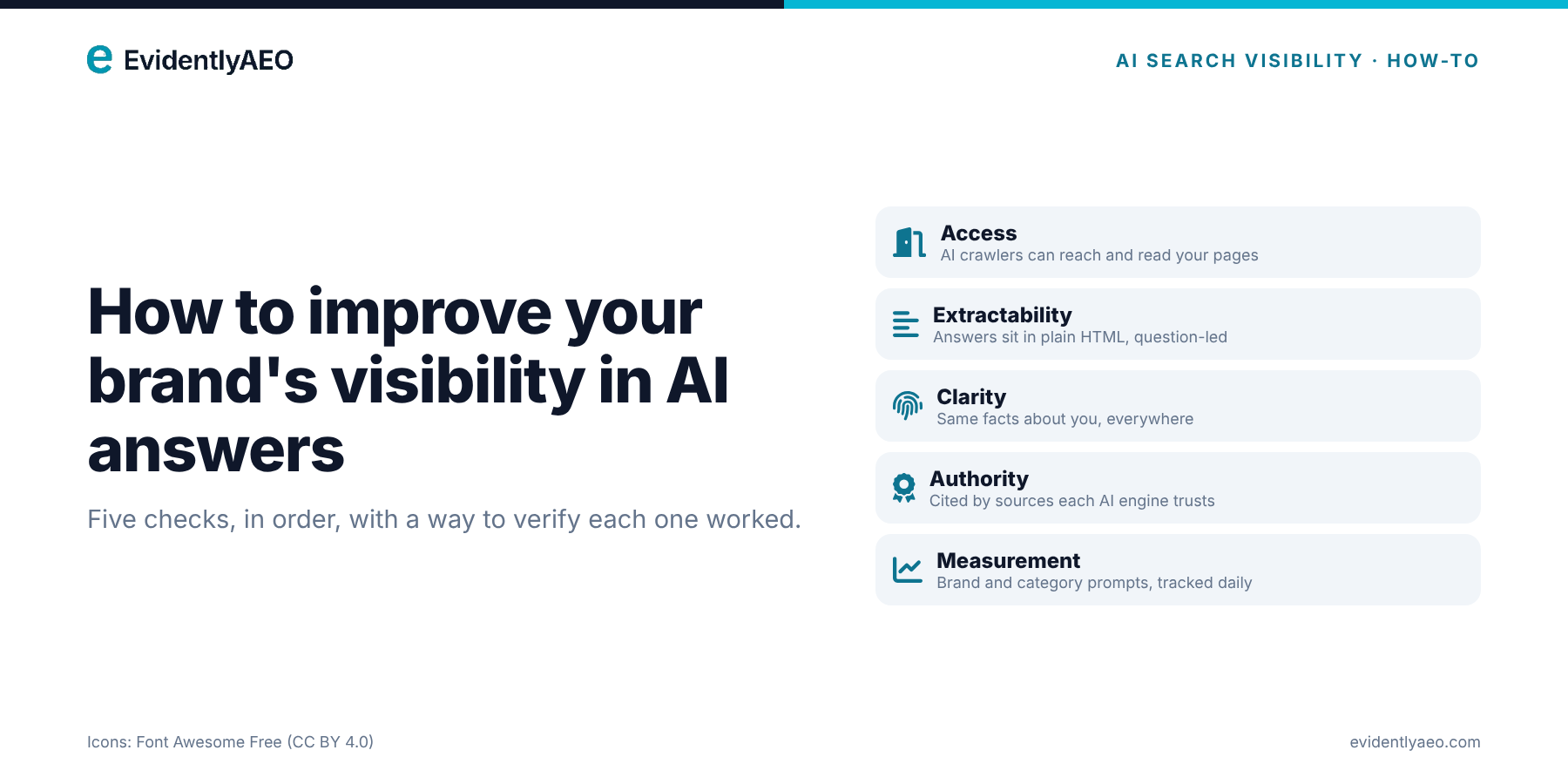
To improve your brand's visibility in AI answers, make sure AI engines can reach your pages, put clear answers in plain text, keep the facts about your brand identical everywhere, get mentioned by the sources each engine already trusts, and measure the same buyer questions every day. Those five checks, in that order, decide whether ChatGPT, Gemini or Perplexity names you.
This guide walks through each check, how to verify it worked, and what we changed on our own site. (New to the topic? Start with what AI search visibility is.)
Why this is different from SEO
A search engine ranks pages. An AI assistant writes one answer and names a handful of brands in it, and the same question can produce a different answer each time. So visibility in AI answers is a rate: how often you are named across many answers, not a single position. Most of the work below also helps SEO, but the order of priorities is different.
Start by measuring two kinds of questions
Before changing anything, write down 20 to 30 questions your buyers actually ask, and split them in two:
- Brand questions name you ("What is EvidentlyAEO?"). They test whether AI engines describe you correctly.
- Category questions don't ("best AEO tools", "how to track brand mentions in ChatGPT"). They test whether AI engines recommend you. This is where visibility is won or lost.
When we ran our own fixed set of category questions in Perplexity on 20 October 2026, EvidentlyAEO appeared in 0 of 10 answers, while all 6 brand questions described us correctly. That gap, known by name but missing from the shortlist, is the most common starting point we see.
The five checks
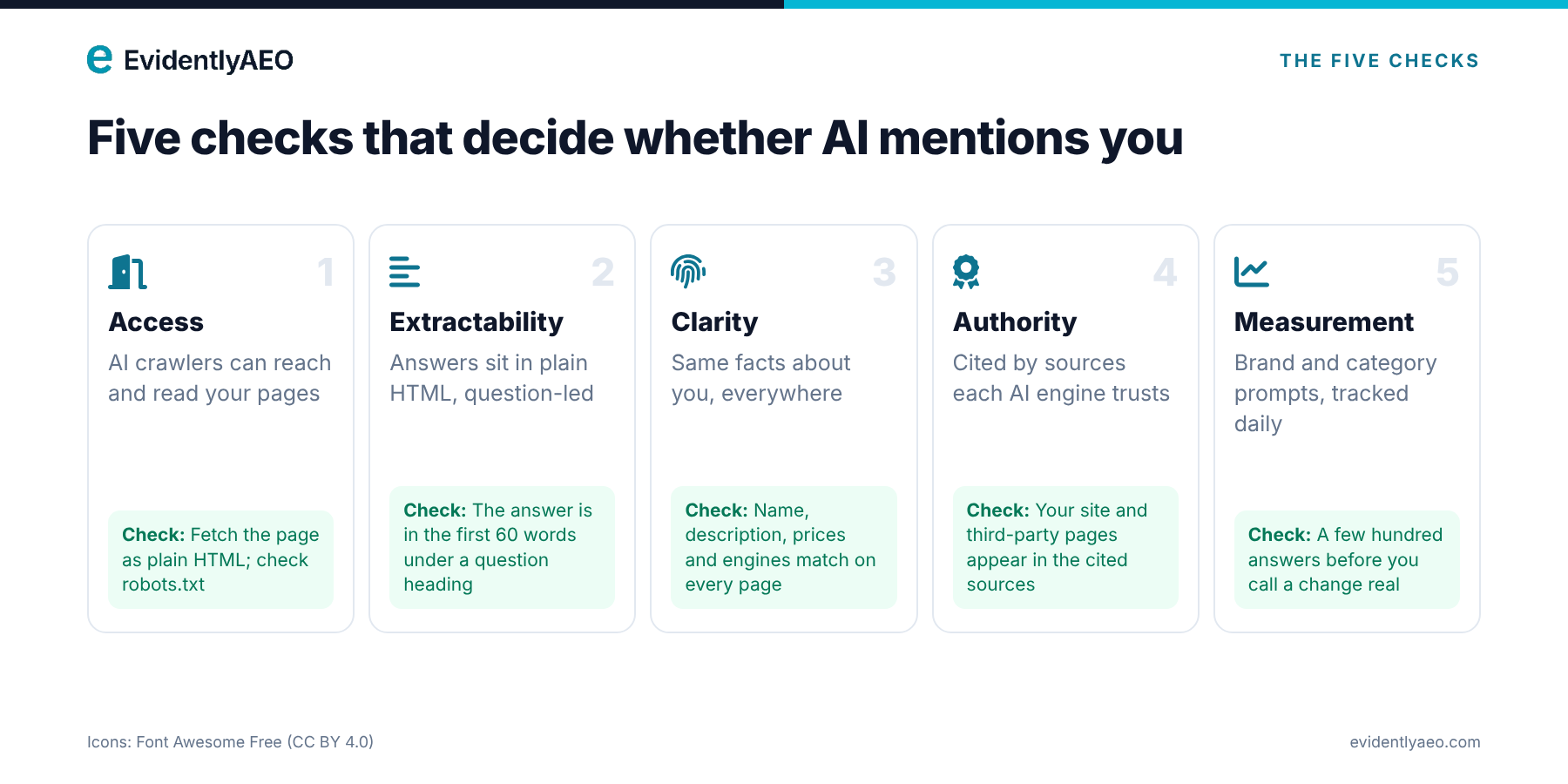
Figure: The five checks that decide whether AI mentions you, and how to verify each
1. Access: can AI engines reach your pages?
AI assistants that search the web live can only cite pages their crawlers can fetch. Check your robots.txt does not block the crawlers the AI providers publish for search, such as OpenAI's OAI-SearchBot and PerplexityBot, and that your key pages are indexed in Google and Bing, because several assistants draw on those indexes.
Verify it: open each important page with JavaScript turned off. If the main text disappears, many crawlers will not see it either. Then confirm the page is indexed in Google Search Console and Bing Webmaster Tools.
2. Extractability: is the answer easy to lift?
AI engines quote passages, not pages. Put a direct answer of 40 to 60 words under a heading phrased as the question, keep FAQs as real text in the page (not hidden in scripts), and use lists and tables for steps and comparisons.
Verify it: read only the first paragraph under each heading. If it answers the heading on its own, it can be quoted.
What we changed: in October we rebuilt our What is AEO guide so its FAQ answers sit in the page's HTML, and we're adding FAQ structured data to our pricing page, built from the same text visitors see.
3. Clarity: are your facts the same everywhere?
AI engines combine what your site, review sites, directories and articles say about you. If your product description, pricing or features differ between them, the answer becomes vague or wrong. Keep one list of approved facts and fix every page and profile that disagrees.
Verify it: ask two or three assistants "What is [your brand] and how much does it cost?" and compare the answers with your facts list.
What we changed: our own site once listed 4, 5 or 8 AI engines on different pages. We moved every public fact into a single source and now show the same 7 engines everywhere. In November we also caught a homepage FAQ that promised "unlimited brands", which our plans don't offer, and we're correcting it. Because our name is close to an unrelated company, Evidently AI, we also state the difference plainly on the site.
4. Authority: are you cited by sources the engines trust?
For category questions, assistants lean heavily on third-party sources: comparison articles, review sites, news, forums and video. Find the sources each engine cites for your category, then earn a place in them with data, expert comment or a fair inclusion request.
Engines differ a lot here. In our public AI Midterms Tracker on 1 November 2026, 38% of Google AI Mode's citations came from social media and video, against close to zero for ChatGPT. The sources that matter depend on which assistant your buyers use. Our guide on how to see which sources ChatGPT cites shows how to find them.
Verify it: re-run your category questions and check whether the cited sources now include your site or pages that mention you.
What we changed: in late October we contacted the publications and comparison sites that appear most in AI answers about AEO tools, offering data rather than asking for links, and published our own fair comparison of tracking tools with every vendor fact sourced.
5. Measurement: are you tracking it properly?
Run the same questions on the same engines every day, and report brand presence and share of answer with the number of answers behind them. A change of 10 points on 20 answers is noise; you need a few hundred answers before calling a change real. Our guide to AI search visibility metrics explains the seven KPIs and the sample sizes. For visits, use the AI Assistant channel in GA4, and expect it to undercount (here is why).
Your first 30 days
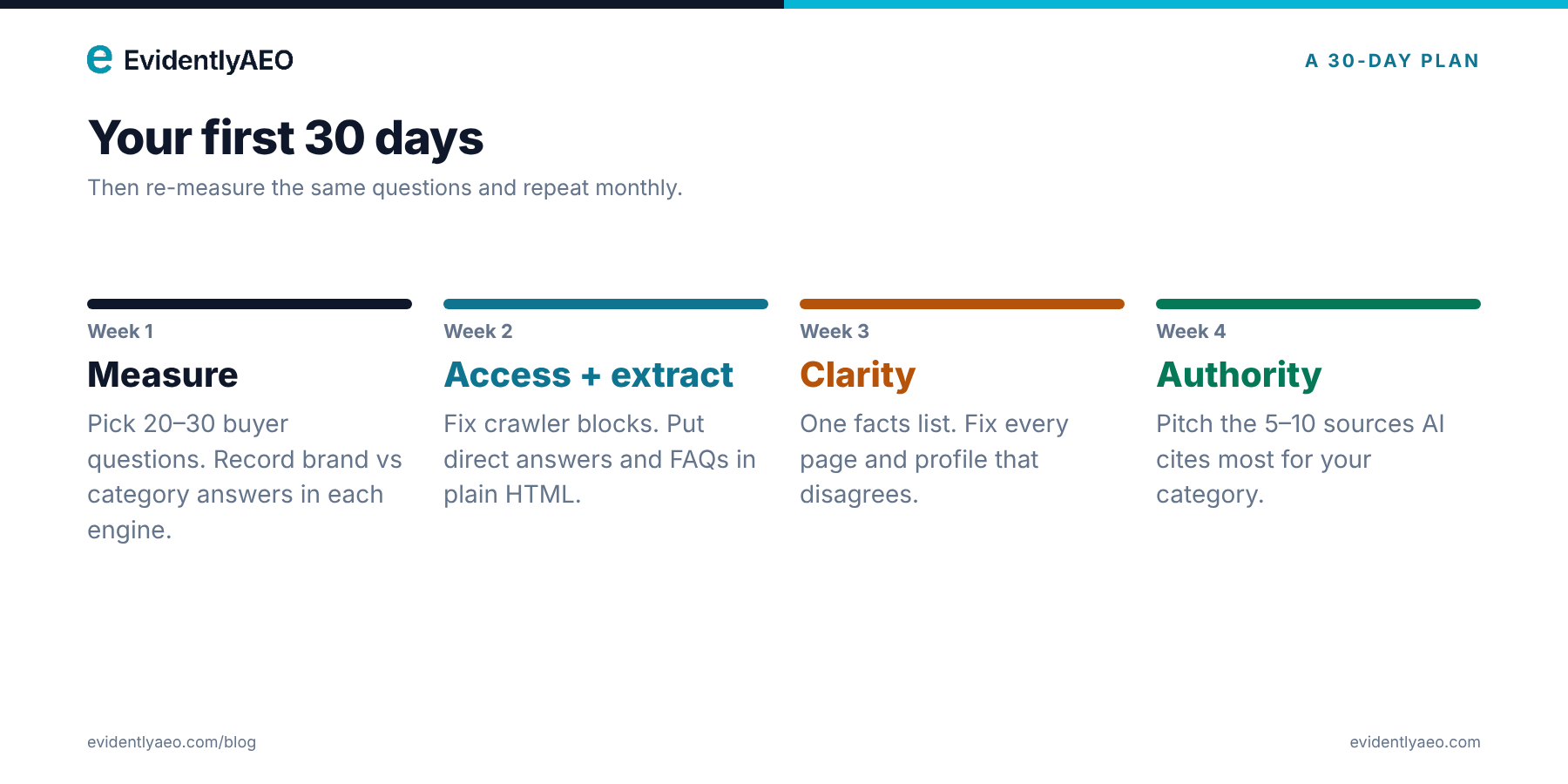
Figure: A 30-day plan to improve your visibility in AI answers
- Week 1, measure: pick 20 to 30 buyer questions and record brand and category answers in each engine you care about.
- Week 2, access and extractability: remove crawler blocks and put direct answers and FAQs in plain text on your most important pages.
- Week 3, clarity: write one facts list and correct every page and profile that disagrees.
- Week 4, authority: list the 5 to 10 sources AI engines cite most for your category and start earning a place in them.
Then re-measure the same questions and repeat monthly. Indexing takes days; showing up in AI answers usually takes weeks to months, and is never guaranteed (how long it realistically takes).
If a competitor keeps getting recommended instead of you
That usually means they win on check 4: more independent sources describe them for your category. Our answer on why ChatGPT recommends a competitor instead of you covers the most common reasons and how to close the gap.
EvidentlyAEO runs these checks for you: it tracks what ChatGPT, Gemini, Perplexity and other engines say about your brand every day, shows which sources they cite, and turns gaps into content and outreach tasks. Book a free AI visibility audit to see where you stand today.
Frequently asked questions
**How do I get my brand mentioned by ChatGPT?**Make sure your pages can be crawled and give direct answers, keep your facts consistent across the web, and get included in the third-party sources ChatGPT cites for your category. Then track the same questions daily to see what changes.
**Does SEO help with AI visibility?**Partly. Being crawlable, indexed and clearly written helps both. But AI answers lean more on third-party sources and consistent facts than on your own rankings.
**Why doesn't AI recommend my brand?**Usually because few independent sources describe you for that category, or because the facts about you are inconsistent. Check whether engines describe you correctly when asked by name; if they do, the gap is authority, not awareness.
**How long does it take to improve AI visibility?**Technical fixes can be indexed within days. Changes in AI answers usually take weeks to months, and should be judged on a few hundred tracked answers, not a single check.


