AI Search Visibility Metrics: The 7 KPIs That Matter
The KPIs that matter for AI search visibility are the ones that answer three questions: do AI engines mention you, do they recommend you over competitors, and does that lead to visits and pipeline. Seven metrics cover all three. This guide gives the formula for each, what a good result looks like, and the part most reports skip: how many answers you need before a change is real rather than noise. (New to the topic? Start with our guide to AI search visibility.)
Why rankings don't work for AI answers
In Google, a page holds a position. In ChatGPT, Gemini or Perplexity, the same question can produce a different answer each time it is asked, with different brands named in a different order. So AI visibility is measured as a rate across many answers, not a single position. (We covered why in No Rank #1 in ChatGPT.)
The 7 KPIs
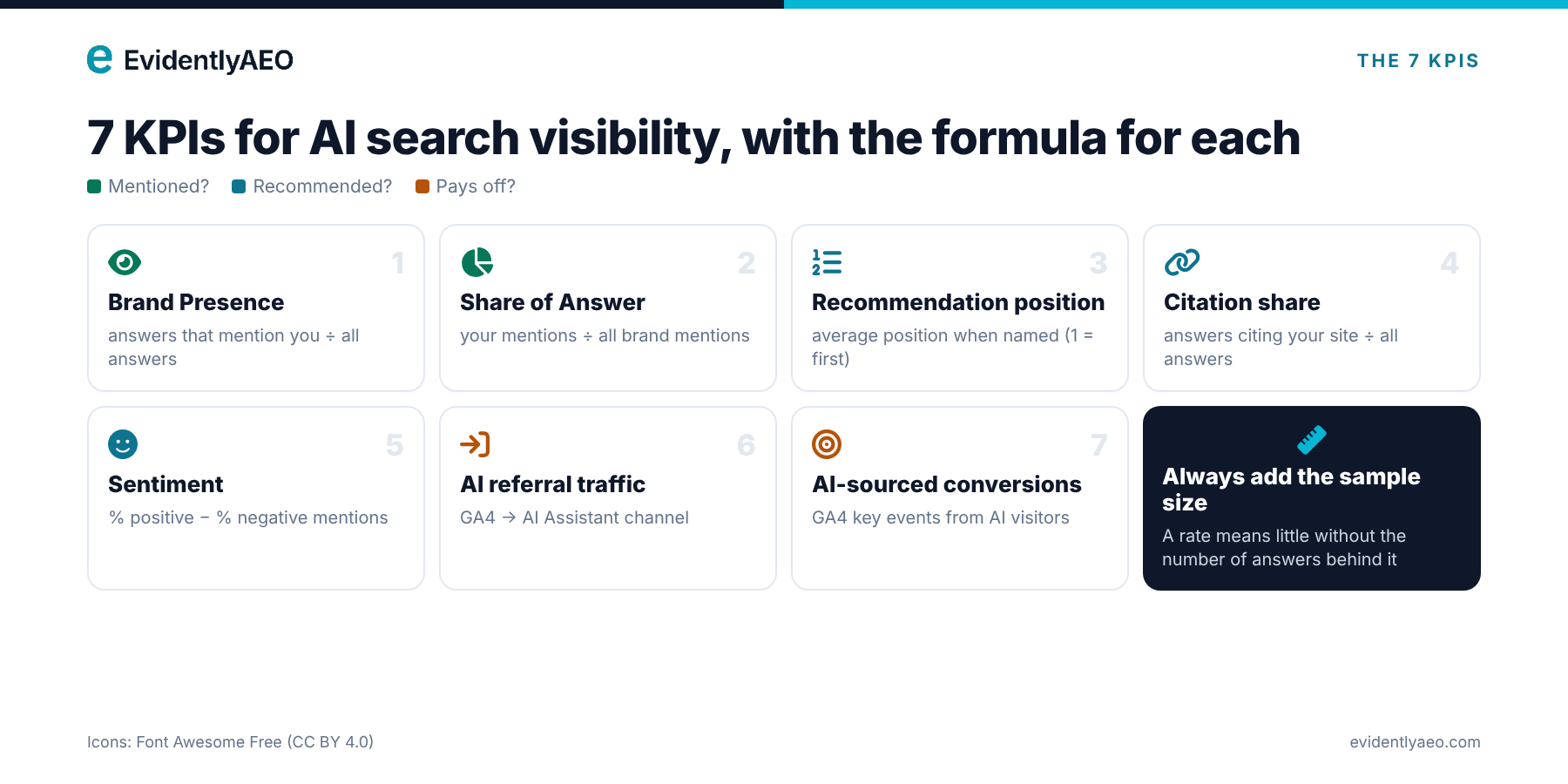
Figure: The 7 KPIs for AI search visibility, with the formula for each
1. Brand Presence (mention rate). The share of tracked answers that mention your brand at all. Formula: answers that mention you ÷ all tracked answers. This is the headline number. If it is near zero, nothing else matters yet.
2. Share of Answer (AI share of voice). Your share of all brand mentions in your category's answers. Formula: your mentions ÷ mentions of you and every tracked competitor. Presence tells you if you are there; Share of Answer tells you how much of the conversation you own compared with competitors. What is Share of Answer?
3. Recommendation position. Where you appear when an answer lists several brands. Formula: average position across the answers that mention you (1 = named first). Being named fifth in a list of five is very different from being the first recommendation.
4. Citation share. How often AI engines cite your own website as a source. Formula: answers that link to your domain ÷ all tracked answers. Citations are what you can influence most directly with content, and they are the main route from an AI answer to a website visit.
5. Sentiment. Whether AI engines describe your brand positively, neutrally or negatively, and which attributes they repeat. Formula: share of mentions that are positive, minus the share that are negative. A brand can be mentioned often and still be described as "expensive" or "hard to set up".
6. AI referral traffic. Visits to your site from ChatGPT, Perplexity, Gemini and other assistants. Where: GA4 → Traffic acquisition → AI Assistant channel. Expect it to be undercounted, because many AI visits arrive without a tag or referrer and land in Direct. Our guide How to Track ChatGPT Traffic in GA4 shows how to set it up.
7. AI-sourced conversions. Demo requests, sign-ups or purchases from AI visitors. Where: GA4 key events filtered to the AI Assistant channel. This is the number leadership cares about, and the one that turns AI visibility from a curiosity into a budget line.
How many answers before a change is real?
This is where most AI visibility reports go wrong. Because answers vary from run to run, a small sample swings a lot by chance. A simple rule of thumb: the margin of error on a rate is roughly 1 divided by the square root of the number of answers.
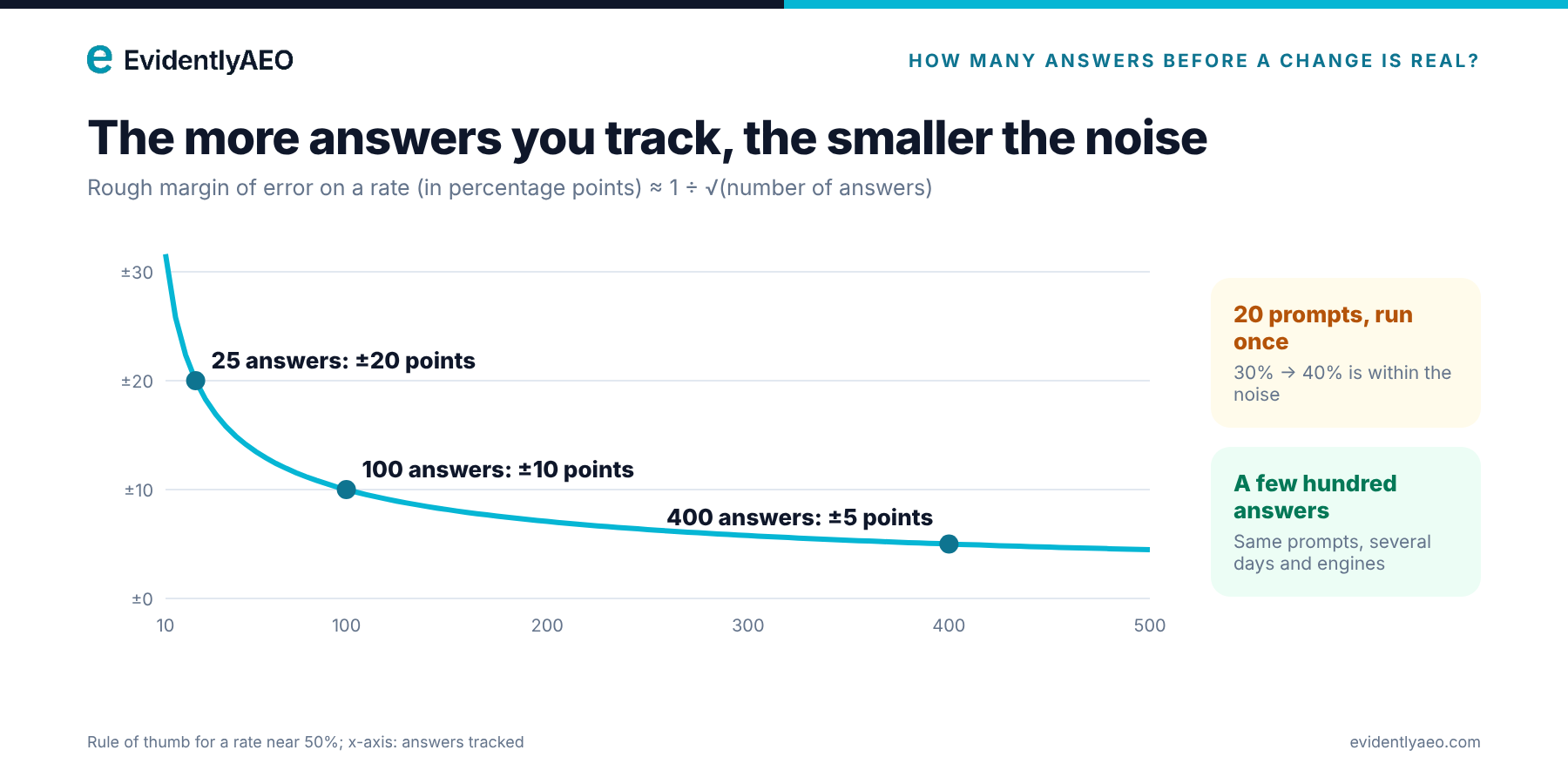
Figure: The more answers you track, the smaller the noise: about ±20 points at 25 answers, ±10 at 100, ±5 at 400
- 25 answers tracked: roughly ±20 points.
- 100 answers tracked: roughly ±10 points.
- 400 answers tracked: roughly ±5 points.
So if you track 20 prompts once and your mention rate moves from 30% to 40%, that is within the noise. Track the same prompts on several days and engines until you have a few hundred answers before you report a change as real. This is also why daily tracking beats a one-off check.
A worked example: our own starting point
We apply the same KPIs to ourselves. When we ran our fixed set of topic prompts in Perplexity on 20 October 2026, EvidentlyAEO appeared in 0 of 10 non-brand answers ("best AEO tools", "best AI visibility tools" and similar), while all 6 brand prompts named us correctly. In GA4, the AI Assistant channel sent us 8 sessions in the 28 days to 25 October.
That gives us a clear baseline: Brand Presence for non-brand prompts is 0%, AI referral traffic is small and partly hidden in Direct, and AI-sourced conversions are not yet measurable. The first goal is to move non-brand presence from 0 to 1, then to 3 of 10, before worrying about position or sentiment.
How to report AI visibility to leadership
Keep it to one slide a month:
- Brand Presence and Share of Answer for a fixed set of buyer prompts, with the sample size.
- The two competitors who gained or lost the most.
- Top cited sources in your category, and whether your site is one of them.
- AI referral sessions and conversions from GA4.
- What we changed this month and what we expect it to move.
For why this belongs in front of the board, see The Measurement Crisis Your Board Isn't Ready For.
Frequently asked questions
**What is the most important AI search visibility metric?**Brand Presence for non-brand buyer prompts. If AI engines don't mention you when buyers ask about your category, the other metrics have nothing to measure.
**What is the difference between Share of Answer and share of voice?**They describe the same idea: your share of brand mentions compared with competitors. Share of Answer is the term used for AI answers.
**How often should I measure AI visibility?**Daily tracking with monthly reporting. Daily runs build the sample size; monthly reporting smooths out the noise.
**Can I measure AI visibility for free?**You can check by hand by asking ChatGPT or Perplexity your buyers' questions in a fresh chat, but you will need hundreds of answers before trends are reliable, which is where a tracking tool helps. We compare the options in Tools to Track Brand Mentions in ChatGPT and Gemini, or see how EvidentlyAEO tracks it.
Icons in images: Font Awesome Free (CC BY 4.0).


